
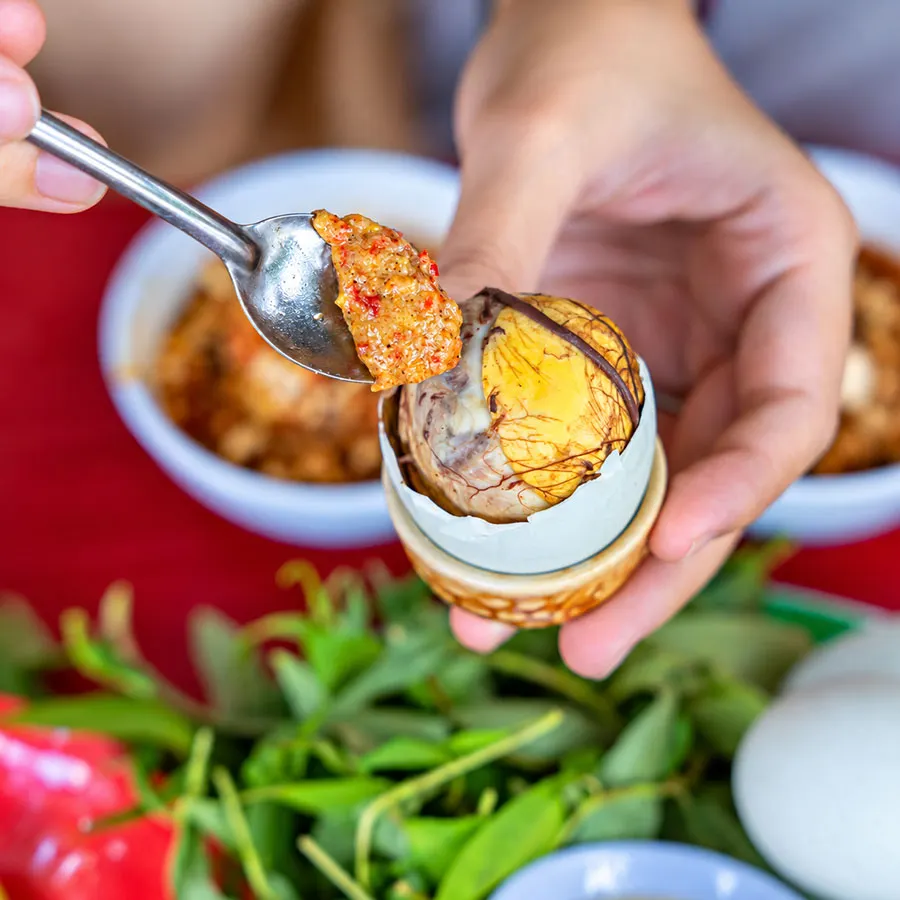






One tiny egg, a very curious traveler, and a breakfast decision that suddenly requires a family meeting.
When people think about Vietnamese food, they usually imagine steaming bowls of pho, crispy bánh mì, fresh spring rolls, and little cups of strong coffee that could wake up someone who has been asleep since the previous century.
Nobody warns you that one day, you might be sitting on a tiny plastic stool, holding a duck egg, wondering whether your adventurous spirit has finally gone too far.
Welcome to Vietnam. Meet trứng vịt lộn.
Known internationally as balut, this traditional Vietnamese snack is a fertilized duck egg that has been incubated until the embryo has developed, then boiled and served hot in its shell.
I had eaten plenty of eggs before. Scrambled eggs. Fried eggs. Eggs in sandwiches. Eggs that appeared in mysterious hotel breakfasts and were best left unquestioned.
But this was different.
The egg looked innocent enough. Small, warm, and perfectly ordinary from the outside.
Which, as I was about to discover, was a rather misleading first impression.
The Egg That Makes You Pause Mid-Sentence
My introduction to trứng vịt lộn began at a modest street-side eatery. There were little stools, a few tables, and the comfortable atmosphere of a place where people had come to eat rather than photograph their lunch from seventeen different angles.
A local diner ordered an egg as casually as someone else might order a sandwich.
Then the vendor placed one in front of me.
I stared at it.
The egg stared back, metaphorically speaking. Eggs are not famous for their conversational skills.
“So,” I thought, “this is happening.”
For many Vietnamese people, trứng vịt lộn is a familiar snack or breakfast food. It is not necessarily a dramatic culinary adventure. Nobody needs to ring a bell or award a medal when it arrives.
For a first-time foreign visitor, however, the knowledge of what is inside can make that ordinary-looking shell feel surprisingly intimidating.
And that is the funny thing about food: sometimes your imagination creates a much bigger obstacle than your taste buds do.
I had arrived hoping to discover Vietnamese cuisine. Apparently, Vietnamese cuisine had decided to discover me first.
What Exactly Is Inside?
 Let's clear up the mystery before anyone orders one by accident.
A regular boiled duck egg contains the familiar yolk and egg white. Trứng vịt lộn is different because the fertilized egg has been incubated, allowing a developing duck embryo to form inside.
Once cooked, the egg contains several distinct elements: savory liquid, rich yolk, egg white, and the developing embryo. The exact texture and appearance vary according to how far the egg has developed.
That combination is what makes balut so different from an ordinary boiled egg.
It is also why people can have very different reactions to it. Some are curious about the flavor. Others struggle with the idea before they have even picked up a spoon.
Neither reaction is particularly surprising.
After all, most of us grow up with an invisible list of foods that count as “normal.” The list changes depending on where we live. Something familiar in one country can seem extraordinary in another.
And if you think about it, a regular chicken egg is already a fairly remarkable invention. Nature packages breakfast in its own little container and even gives it a built-in lid.
We simply stopped questioning it because we have been eating eggs for years.
The First Bite: Less Scary Than the Imagination?
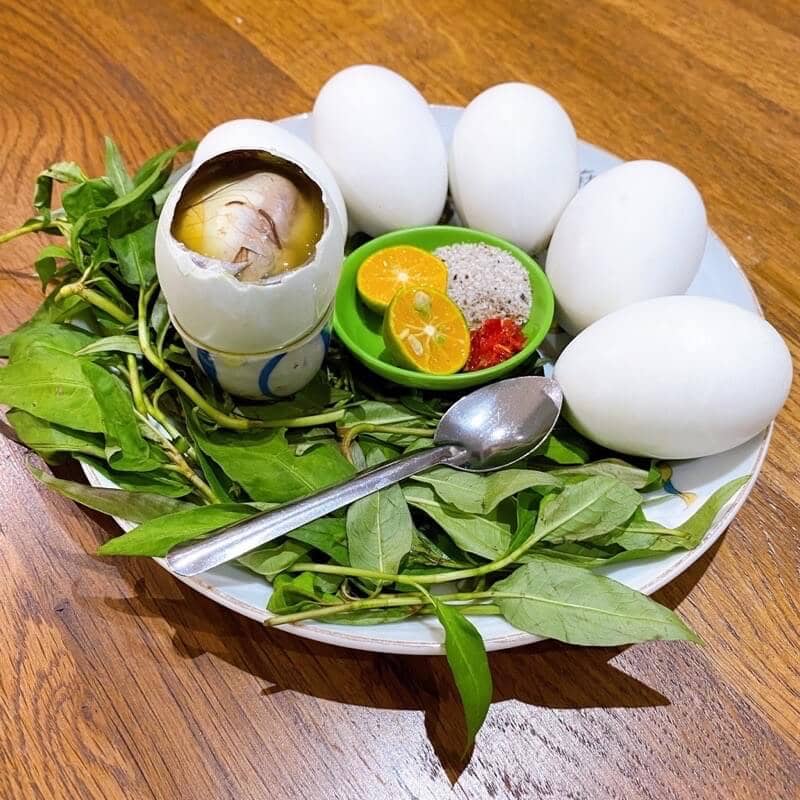 In Vietnam, trứng vịt lộn is usually served hot, often with Vietnamese coriander, known as rau răm, and a mixture of salt, pepper, and lime or kumquat juice. Some places also offer ginger or chili.
These accompaniments matter. The herb has a distinctive peppery aroma, while the citrus adds freshness and acidity to balance the richness of the egg.
The traditional way of eating it is fairly simple. Crack open the shell, taste the warm savory liquid inside, then eat the remaining contents with the seasonings and herbs.
No elaborate cutlery. No fancy plating. No waiter arriving to explain the artistic concept behind the arrangement.
Just you, an egg, and a decision.
The flavor is generally rich and savory, with a combination of egg, broth, and tender poultry-like notes. The yolk is creamy, while the other parts have different textures.
For some first-timers, the appearance and texture are the biggest hurdles rather than the flavor itself.
I can understand that. When you know what you are looking at, every bite becomes an opportunity for your brain to hold an emergency meeting.
“Are we enjoying this?”
“Possibly.”
“Are we sure?”
“Could we please discuss the herbs instead?”
The good news is that food experiences do not need to turn into tests of courage. If you are curious, you can take your time, ask questions, and decide whether you want to try it. If it is not for you, that is a perfectly respectable conclusion.
No one needs to earn a travel certificate by finishing an egg.
Why Do Vietnamese People Eat It?
 Here is where the story becomes more interesting than a simple “weird food” headline.
Trứng vịt lộn is part of everyday food culture in Vietnam. It is commonly sold at small eateries and street-food stalls, and people enjoy it as a casual meal or snack.
In Hanoi, you may find it eaten for breakfast. In other places, it is often associated with the late afternoon or evening. Eating habits vary by region, household, and personal preference.
For locals who grew up with the dish, it may bring back familiar memories: stopping for a quick bite, sharing food with friends, or enjoying something warm at the end of a busy day.
That is a very different experience from the way balut is sometimes presented online—as a food designed to shock tourists.
Imagine if someone traveled to another country, saw your favorite comfort food, and announced that eating it was an extreme sport.
You would probably want to ask whether they had tried the local desserts yet.
Of course, not every Vietnamese person loves trứng vịt lộn. Some eat it regularly, some enjoy it occasionally, and others avoid it altogether. A traditional dish can be widely recognized without being universally adored.
That is true of food everywhere. Even pizza has critics, although I suspect they are simply having a difficult week.
The important point is that trứng vịt lộn is more than a challenge for adventurous visitors. It is part of the ordinary food landscape for many people in Vietnam.
Rau Răm: The Small Herb Doing a Big Job
 One of the most interesting parts of eating trứng vịt lộn is the combination of ingredients around it.
The egg is rich, warm, and savory. Then comes rau răm, with its fresh, peppery flavor. Salt and pepper add seasoning, while lime or kumquat brings a little sharpness.
Suddenly, the dish becomes more than the sum of its parts.
This is a useful lesson for anyone exploring Vietnamese cuisine: the accompaniments are often just as important as the main ingredient.
Vietnamese meals frequently balance different flavors and textures. Fresh herbs, citrus, dipping sauces, and crunchy vegetables can transform a dish, adding contrast instead of simply making it hotter or saltier.
You might discover this with a bowl of phở, a plate of bún chả, or a simple dish of grilled meat wrapped in fresh herbs.
With trứng vịt lộn, the herbs help create a balance that makes sense once you taste the components together.
They also give your hands something useful to do while your brain finishes its ongoing discussion about the egg.
It Is Not Just One Dish, Either
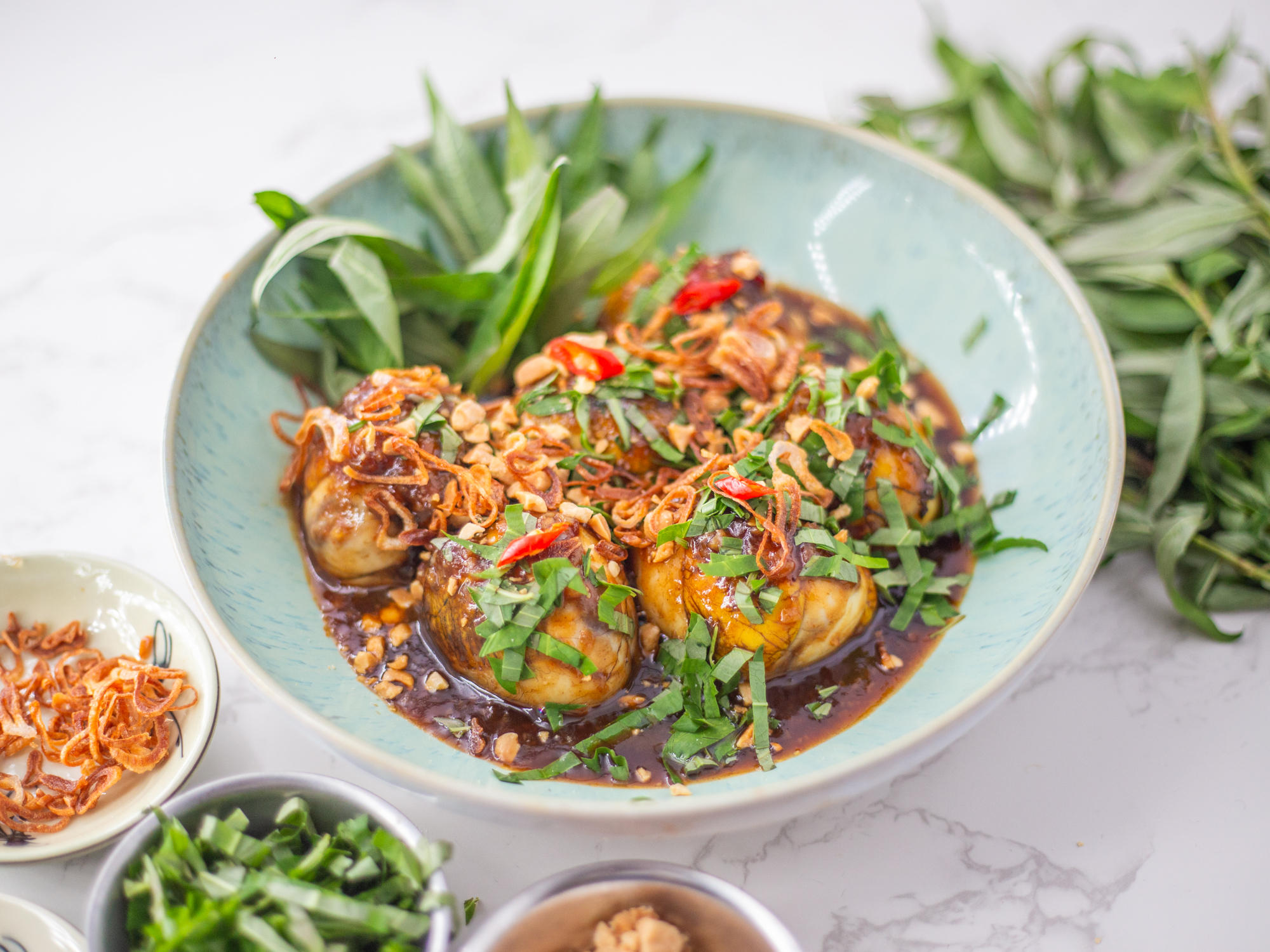 Vietnamese cooks have found different ways to prepare duck embryo eggs.
The classic version is boiled and served in the shell, but you may also encounter hột vịt lộn xào me, a preparation in which the eggs are cooked with tamarind sauce.
The tamarind adds a sweet-and-sour flavor, often accompanied by savory seasoning and herbs. It is a different experience from the simple boiled version, showing how Vietnamese cooking can take one ingredient and give it another personality.
Think of it as the egg changing outfits.
The boiled version is casual and straightforward. The tamarind version arrives with a more elaborate flavor profile and a little extra drama.
If you are exploring Vietnamese street food, this is part of the fun: familiar ingredients can appear in several forms, depending on the cook, the region, and the way a dish is served.
Just remember that not every vendor offers every preparation. Street food menus are not universal catalogues, and a stall selling one specialty may not have the entire egg universe available.
How to Approach Balut Without Turning It Into a Dare
If you are visiting Vietnam and feel curious about trứng vịt lộn, a little preparation can make the experience more comfortable.
First, understand what you are ordering. It is a fertilized duck egg with a developing embryo, not simply a duck egg with an unusually dramatic yolk.
Second, choose a reputable vendor and make sure the egg is thoroughly cooked and served hot. As with other cooked foods, safe handling matters.
Third, ask a local or the vendor how the dish is usually eaten. A simple question can teach you more than a dozen videos of travelers making surprised faces.
And finally, approach it with curiosity rather than pressure.
You do not have to eat something just because it is famous, traditional, or popular with other travelers. You can learn about a dish, understand its cultural context, and still decide that it is not for you.
That is part of being a respectful traveler, too.
The goal is not to collect the largest possible number of unusual foods like stamps in a passport. The goal is to discover something about the place you are visiting—and perhaps about your own tastes along the way.
So, Would I Try It Again?
Here is my verdict: trứng vịt lộn deserves a more thoughtful introduction than a dramatic warning label and a camera pointed at someone's shocked expression.
Its appearance may challenge visitors who have never encountered it before. Its flavor is rich and savory, its traditional accompaniments are distinctive, and its place in Vietnamese food culture makes it worth understanding.
Would every traveler love it? Certainly not.
Would I recommend learning about it if you are curious about Vietnam's food traditions? Absolutely.
And would I still pause for a moment before opening that shell?
Probably. Curiosity is powerful, but it does not always defeat the instinct to inspect your breakfast very carefully.
The next time you visit Vietnam, you might find yourself at a little street-side table, surrounded by the sounds of everyday life, watching locals enjoy a dish that is completely ordinary to them and entirely new to you.