
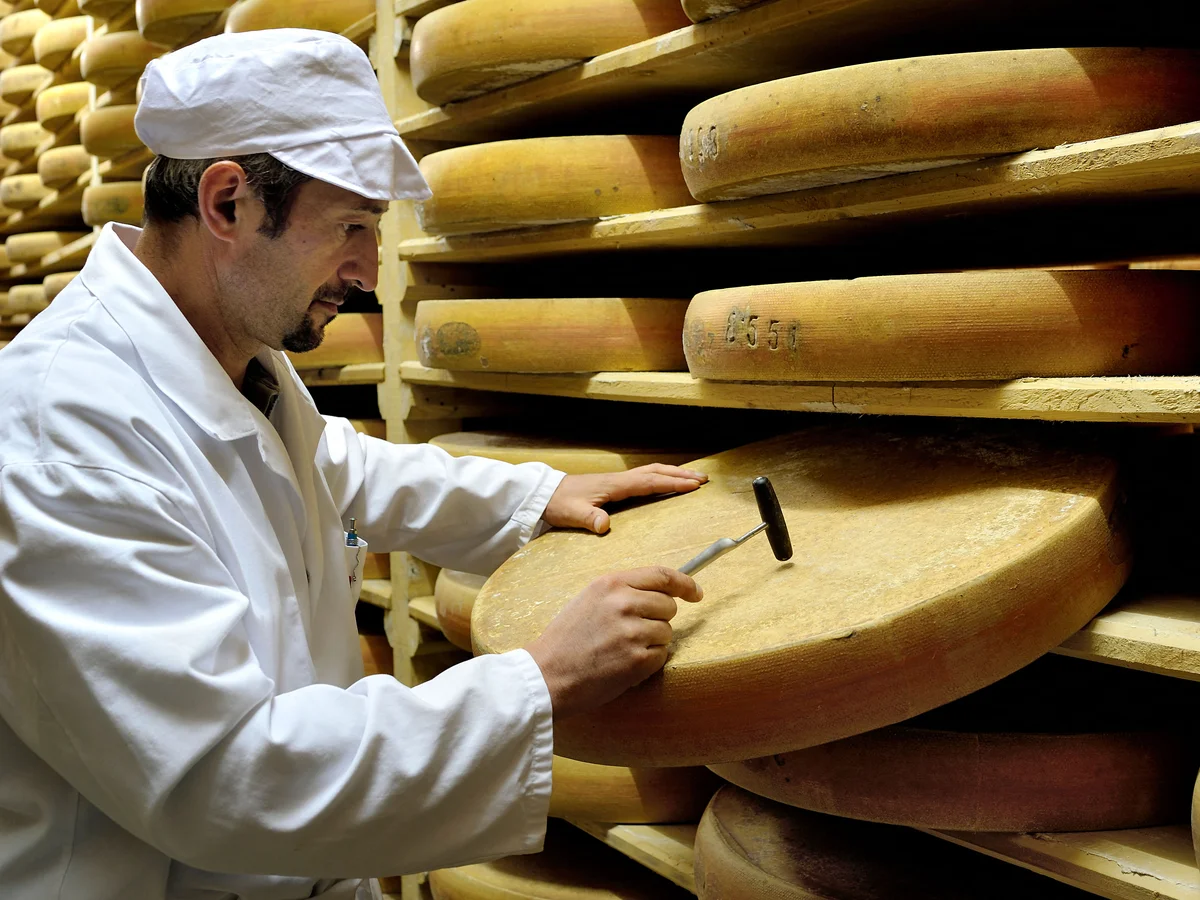






Imagine walking into a cool, dimly lit cellar. Wooden shelves stretch along the walls, each one packed with enormous wheels of cheese. Some are pale and smooth, others are covered in fuzzy white coats, while a few look as if they've just returned from a very muddy adventure.
And there, moving quietly between the shelves, is someone carefully turning a cheese wheel, brushing its rind and checking its surface.
No, they're not preparing a giant cheese platter. They're looking after their very precious charges.
Welcome to the world of cheese affineurs – the specialists who help cheese grow up.
Their workplace might be an underground cellar, a mountain cave or a carefully controlled aging room. Their daily routine involves temperature checks, humidity control, brushing, washing, turning and tasting. In other words, they spend their days doing things that most people would never imagine were necessary to keep a piece of cheese happy.
And believe it or not, the difference between an ordinary cheese and an unforgettable one can depend on these patient professionals.
So, What Exactly Is a Cheese Affineur?
The word affineur comes from the French tradition of cheese aging, known as affinage.
To understand the job, it helps to know that making cheese and aging cheese are two different stages.
A cheesemaker transforms milk into cheese. But when a fresh cheese wheel leaves the dairy, its journey may be far from over. Depending on the variety, it might need weeks, months or even years before it develops the flavor and texture people love.
That's where the affineur steps in.
Think of the cheesemaker as the person who gives cheese life, and the affineur as the person who helps it reach its full potential. They create the right environment and provide the care needed during maturation.
Some affineurs work closely with individual cheesemakers, while others manage specialist aging cellars containing cheeses from different producers.
Their job is not simply to wait until the calendar says the cheese is ready. They must understand how each cheese behaves and know when to intervene – and when to leave it alone.
It's a little like looking after a group of very demanding houseplants, except these plants weigh 40 kilograms and smell considerably stronger.
Inside a Cheese Cave: Where the Magic Happens
A traditional cheese-aging cellar can look like something from a historical film. Thick stone walls, wooden shelves, cool air and rows upon rows of cheese wheels create an atmosphere that feels far removed from a modern supermarket.
But behind the rustic appearance is a surprisingly precise process.
Temperature, humidity and airflow all influence how cheese matures. If the air is too dry, a cheese may lose moisture too quickly and develop an overly hard rind. If conditions are too damp, unwanted surface growth or other problems may appear.
Different cheeses also have different preferences.
For example, Gruyère AOP is matured in cellars with conditions designed for its slow development. Its wheels are turned and brushed with salt water, and the aging process can last from around five to eighteen months. Some are kept even longer for more intense flavors.
There is no universal cheese spa temperature. A soft-ripened cheese, a blue cheese and a hard mountain cheese may need very different environments.
The affineur must understand these differences and adjust the cellar accordingly.
In a way, the cellar is not just a storage room. It's part of the cheese's personality.
The Daily Routine: Turn, Brush, Wash, Repeat
If you imagine an affineur spending the day sitting in a cellar, admiring beautiful cheese wheels while sipping wine, think again.
The work can be surprisingly physical and repetitive.
One of the most common tasks is turning the cheese. Large wheels are carefully flipped so that moisture and pressure are distributed more evenly and the cheese develops consistently.
Some cheeses need brushing to remove unwanted surface growth or maintain the desired rind. Others are washed with salted water or brine, sometimes according to a carefully planned schedule.
At the Basque cheese dairy Onetik in France, for example, affineurs turn, wash and brush certain cheeses every seven to ten days. During these checks, they also inspect the quality and monitor how the cheese is developing.
And no, they cannot simply give every wheel the same treatment.
One cheese might need a gentle brush, another a wash, and another almost no intervention at all. The right technique depends on the variety, its age and the condition of its rind.
Blue cheeses have their own special requirements. In some varieties, the cheese is pierced with needles to allow oxygen to enter and help the characteristic blue veins develop inside.
So yes, someone really does sit there poking holes in cheese – but there's a very good reason for it.
A Cheese Affineur Needs All Five Senses
This job isn't just about following instructions or checking a digital thermometer.
Experienced affineurs use their eyes, hands, noses and taste buds to understand what's happening inside each cheese.
They look at the rind for changes in color, texture and growth. They touch the surface to assess its condition and firmness. They smell it for signs of normal development or possible defects.
And, when appropriate, they taste samples to judge how far the cheese has matured.
A cheese that looks ready might still be too young inside. Another might have reached its ideal flavor earlier than expected.
This is why experience matters so much.
An affineur gradually learns how different cheeses behave, how they respond to seasonal changes and how small differences in the cellar can affect the final result.
In other words, they develop a kind of sixth sense – except it's mostly built from years of smelling, touching and tasting cheese.
Not a bad career if you happen to love cheese. Although your friends might start wondering why you can identify a smell from across the room.
Not All Cheese Wants the Same Kind of Treatment
One of the most fascinating things about affinage is that every cheese has its own needs.
Take washed-rind cheeses, for example. Their surfaces are regularly rubbed or washed with brine or other suitable solutions. This encourages the growth of particular surface microorganisms that help create their distinctive colors, aromas and flavors.
That's why some washed-rind cheeses develop striking orange or reddish rinds and have such powerful smells.
Meanwhile, white-mould cheeses such as Brie and Camembert develop their familiar soft, pale rinds through the growth of selected mould cultures.
Blue cheeses follow another path. Their internal blue veins develop with the help of mould cultures and carefully managed oxygen exposure.
Hard cheeses such as Gruyère need a much longer journey. Their wheels are regularly cared for as they gradually become firmer and develop deeper, more complex flavors.
There is no single recipe for looking after cheese. The affineur must know what each variety needs and recognise when something isn't going according to plan.
A one-size-fits-all approach might work for matching T-shirts. It is not a great idea for cheese.
When Is a Cheese Finally Ready?
This might be the most important question in the entire cellar.
And the answer is not always written on a calendar.
Some cheeses are intended to be enjoyed while relatively young and mild. Others need months of maturation to develop the flavors and textures that make them special.
Gruyère AOP offers a good example. Its character changes as it ages: younger versions are generally milder and more delicate, while older ones develop a fuller, more pronounced flavor.
The affineur must decide when a particular batch has reached the right stage.
That decision can involve examining the rind, checking the texture, tasting samples and considering how the cheese will be sold and enjoyed.
Take it out too early, and it may not have developed enough character. Leave it too long, and it may move beyond the desired style.
It's a delicate balance between patience and timing.
Imagine spending months looking after a cheese, only to discover that it needs just two more weeks. That's the sort of situation where a normal person might lose patience – but an affineur simply puts it back on the shelf.
It's Not Just a Job. It's a Craft.
Although modern aging cellars use technology to monitor temperature and humidity, the human element remains essential.
Sensors can tell an affineur that the humidity has changed. They cannot always explain why a particular cheese is behaving differently from the others.
That requires observation, experience and an understanding of the cheese itself.
The profession also connects different parts of the cheese-making world. Affineurs often work with farmers and cheesemakers, learning about the milk, production methods and regional traditions behind each wheel.
In places such as France and Switzerland, cheese aging is closely linked to local food culture. The cellar, the climate, the wooden shelves and the techniques passed down through generations can all contribute to a cheese's identity.
Some aging specialists even experiment with different conditions and treatments to create distinctive results.
The goal isn't necessarily to make every cheese taste stronger. It's to help each one express the qualities that make it special.
Would You Survive a Day in a Cheese Cave?
At first, working in a cheese cellar might sound like a dream job.
You get to spend your day surrounded by cheese. You learn about different varieties, discover fascinating flavors and work with a product that people around the world love.
But there are a few things to consider.
The environment is cool and often humid. The work can involve lifting heavy wheels, repeating the same movements and paying close attention to hundreds of individual cheeses.
And then there's the smell.
A cheese cellar can be wonderfully fragrant to a cheese enthusiast, but it might be a little overwhelming to someone who thinks blue cheese is already pushing the limits of acceptable food behavior.
Still, there's something remarkable about this profession.
A wheel of cheese may spend months or years in a cellar, quietly changing from a young, relatively simple product into something with a distinctive aroma, texture and flavor. And throughout that journey, someone is checking on it, turning it, brushing it and making sure it gets exactly what it needs.
So the next time you cut into a beautifully aged piece of cheese, spare a thought for the person behind it.
They may not have milked the cows or made the original cheese, but they helped it become the delicious thing on your plate.
And somewhere in a cool European cellar, another affineur is probably turning a 30-kilogram cheese wheel – because apparently, even cheese needs someone to turn it over in bed.