

Imagine walking down a busy street in Istanbul on a hot summer afternoon. You spot a colourful ice cream cart, hear the cheerful ringing of a little bell, and think: Perfect. One ice cream, please.
Simple, right?
Wrong.
The vendor hands you an empty cone, waves a giant metal scoop in front of your face, and just when you think you've got your ice cream, he pulls it away. You reach for it again. He spins it around, flips it upside down, and somehow the ice cream is still attached.
At this point, you're no longer buying dessert. You're participating in an unexpected comedy show.
Welcome to the world of Turkish ice cream, or dondurma — where the ice cream is delicious, the vendors are professional pranksters, and customers occasionally leave with slightly less dignity than they arrived with.
But why is Turkish ice cream so stretchy? And why do vendors seem to enjoy making customers work so hard for something that should be incredibly simple?
First, Why Is Turkish Ice Cream So Chewy?
Turkish dondurma isn't quite like the ice cream you might find in an ordinary supermarket.
Traditional Maraş-style dondurma is famous for its unusually thick, elastic texture. Instead of melting and dripping as quickly as many conventional ice creams, it can stretch, bend, and hold its shape remarkably well.
Two ingredients help give it this unusual character:
- Salep: A flour made from the tubers of certain wild orchids. It contains natural compounds that help thicken the mixture and contribute to its elasticity.
- Mastic: A fragrant natural resin obtained from mastic trees. It adds a distinctive aroma and can contribute to the chewy character of some traditional recipes.
Milk and sugar provide the familiar ice cream base, while salep plays a particularly important role in creating that famous stretchy consistency.
The mixture is traditionally worked and churned in a way that develops its dense texture. The result is an ice cream that can feel almost like a cross between a frozen dessert and a very delicious piece of chewing gum.
Not every Turkish ice cream contains exactly the same ingredients or uses the same recipe. Modern versions may use alternative thickeners, and the texture varies between producers.
But the traditional Maraş variety is especially famous for its remarkable elasticity.
And yes, this means you may be able to watch someone hold a scoop of ice cream upside down without immediately losing it.
Try doing that with your usual supermarket vanilla. You'll probably be cleaning your shoes afterwards.
The Ice Cream That Comes With a Free Comedy Show
The real fun begins when you try to buy it.
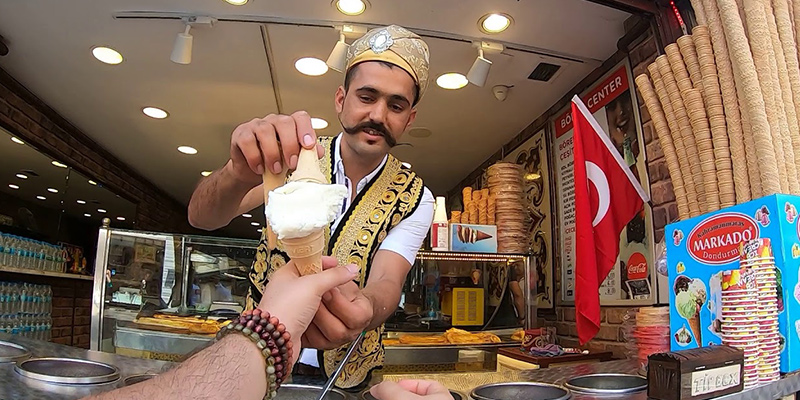
In popular tourist areas of Istanbul and other Turkish cities, some dondurma vendors are famous for their playful performances. They wear traditional-looking outfits, hold long metal serving rods, and use specially designed scoops to stretch and manoeuvre the ice cream.
Their routine is surprisingly well rehearsed.
First, the vendor appears ready to serve you. He places the cone in your hand, raises the scoop, and brings the ice cream close enough for you to grab.
You reach out.
Gone.
He turns the scoop upside down, and the ice cream remains attached. Then he moves it behind your head, swaps the cone, or makes it seem as though your dessert has mysteriously disappeared.
You laugh, reach again, and somehow end up holding an empty cone.
The vendor, meanwhile, looks completely innocent.
If this were a normal supermarket, you'd probably ask for a refund. But here, the performance is part of the attraction.
For tourists, buying dondurma becomes a little street spectacle. People gather around the carts, phones come out, and everyone waits to see how long it takes the customer to finally get the ice cream.
The vendor isn't simply selling a frozen dessert. He's selling a memorable moment.
How Do They Keep Stealing Your Ice Cream?
The secret isn't magic, although the vendors certainly make it look that way.
Their tricks rely on a combination of the ice cream's unusual texture, specially designed serving tools, and a lot of practice.
Traditional Turkish ice cream is dense and elastic, so it can cling to a metal scoop and stretch without immediately breaking apart.
The long-handled scoop gives the vendor extra control. It allows him to lift, twist, stretch, and reposition the ice cream while keeping it attached.
The cone is also part of the performance. The vendor can rotate it, move it away at the last moment, or use the scoop to make the ice cream appear to be placed inside before quickly lifting it back out.
Some routines involve swapping cones or pretending to hand over the dessert before changing direction.
And the most important ingredient?
Timing.
A good vendor knows exactly when the customer will reach for the cone. He also knows how to make the trick look spontaneous, even though he may have performed the same routine hundreds of times.
It's a little like watching a magician, except the assistant is hungry and the disappearing object is dessert.
Why Do Turkish Vendors Do This?
The playful serving style has become a recognisable part of Turkish street-food culture, particularly in tourist destinations.
It helps attract attention in busy streets where vendors compete with countless other food stalls, cafés, and restaurants.
A colourful cart and a delicious ice cream are already appealing. But a vendor who can make customers laugh, surprise them, and create a funny video has something extra.
The performance also turns a simple purchase into an interaction.
Instead of handing over money, receiving a cone, and walking away, customers become part of the show. Children love it, adults often laugh just as much, and people watching nearby may decide they want a turn too.
Social media has helped make these performances even more recognisable. Videos of vendors repeatedly teasing customers with disappearing cones have circulated widely online, introducing dondurma to audiences who may never have visited Turkey.
Of course, not every Turkish ice cream seller performs tricks. Some simply serve the ice cream normally, and that's perfectly fine.
But the playful vendors have helped turn dondurma into more than a dessert. It's now a little piece of Turkish street entertainment.
Where Does This Famous Ice Cream Come From?
One of the most famous traditional varieties is Maraş dondurması, associated with the city of Kahramanmaraş in southeastern Turkey.
The region is known for its dairy traditions and the distinctive ice cream made using salep. The combination of local ingredients and traditional preparation has helped give Maraş dondurması its reputation.
Its texture is so distinctive that it is often served differently from ordinary ice cream. Rather than being scooped into a soft mound, it may be cut, stretched, or served in thicker portions.
You can find dondurma in many parts of Turkey, especially in major cities and tourist areas. Istanbul is an obvious place to encounter the famous street performances, but the dessert itself is not limited to the capital's busy shopping streets.
If you visit Turkey, look for shops advertising Maraş dondurması and ask whether they serve the traditional stretchy variety.
One small thing to remember: salep comes from orchid tubers, and wild orchid harvesting is subject to conservation concerns and regulation. Traditional salep production has faced sustainability challenges, so responsible sourcing matters.
The story of dondurma is not just about a clever serving trick. It's also connected to regional ingredients, food heritage, and the people who have kept the tradition alive.
What Does It Actually Taste Like?
After all that drama, you'd hope the ice cream tastes good.
Fortunately, it has more going for it than its ability to escape from a cone.
Traditional dondurma often has a rich milky flavour, with a dense, creamy texture and a distinctive chewiness. It doesn't melt in quite the same way as ordinary ice cream, so eating it can feel like a completely different experience.
Popular flavours include vanilla, chocolate, pistachio, and fruit varieties, although the selection depends on the shop.
Mastic can add a subtle aromatic note, while salep contributes to the thick texture rather than acting as a strong flavour on its own.
If you're expecting a light, fluffy scoop that disappears after three bites, you may be surprised. Dondurma is more substantial and requires a little patience.
Which is rather ironic, considering you've probably already spent several minutes trying to convince the vendor to give it to you.
A Few Tips Before You Buy
If you're planning to try Turkish ice cream, here are a few things worth remembering:
1. Don't take the performance too seriously. The teasing is usually friendly entertainment. Laugh along and enjoy the experience.
2. Keep hold of your cone. The vendor may try several tricks, so don't be surprised if the ice cream takes a little longer to reach you than expected.
3. Ask about the ingredients. Traditional Maraş dondurması may contain salep and sometimes mastic. If you have allergies or dietary restrictions, check with the seller.
4. Bring a little patience. If you're in a hurry, choose a shop that serves the ice cream without the performance.
5. Don't forget to taste it! After all, you're buying ice cream, not just a starring role in somebody else's comedy video.
So, Is It Worth Trying?
Absolutely — especially if you enjoy discovering food that comes with a story.
Turkish dondurma offers something different from the familiar scoop of ice cream. Its unusual texture makes it fascinating, its regional history gives it cultural significance, and its playful street vendors turn an ordinary dessert purchase into a memorable experience.
The best part may not even be the ice cream itself. It could be the moment when you finally manage to catch the cone, look triumphantly at the vendor, and realise that you've just spent five minutes negotiating with a man over a scoop of vanilla.
And if he tricks you one last time?
Well, at least you can say you got a good show.
Just remember: in Turkey, the ice cream may be stretchy, but your patience will be stretched even further.