
Imagine arriving in Vietnam and deciding to try some authentic street food.
You find a busy little food stall, smell something delicious cooking nearby and spot an empty seat. Perfect!
Then you look down.
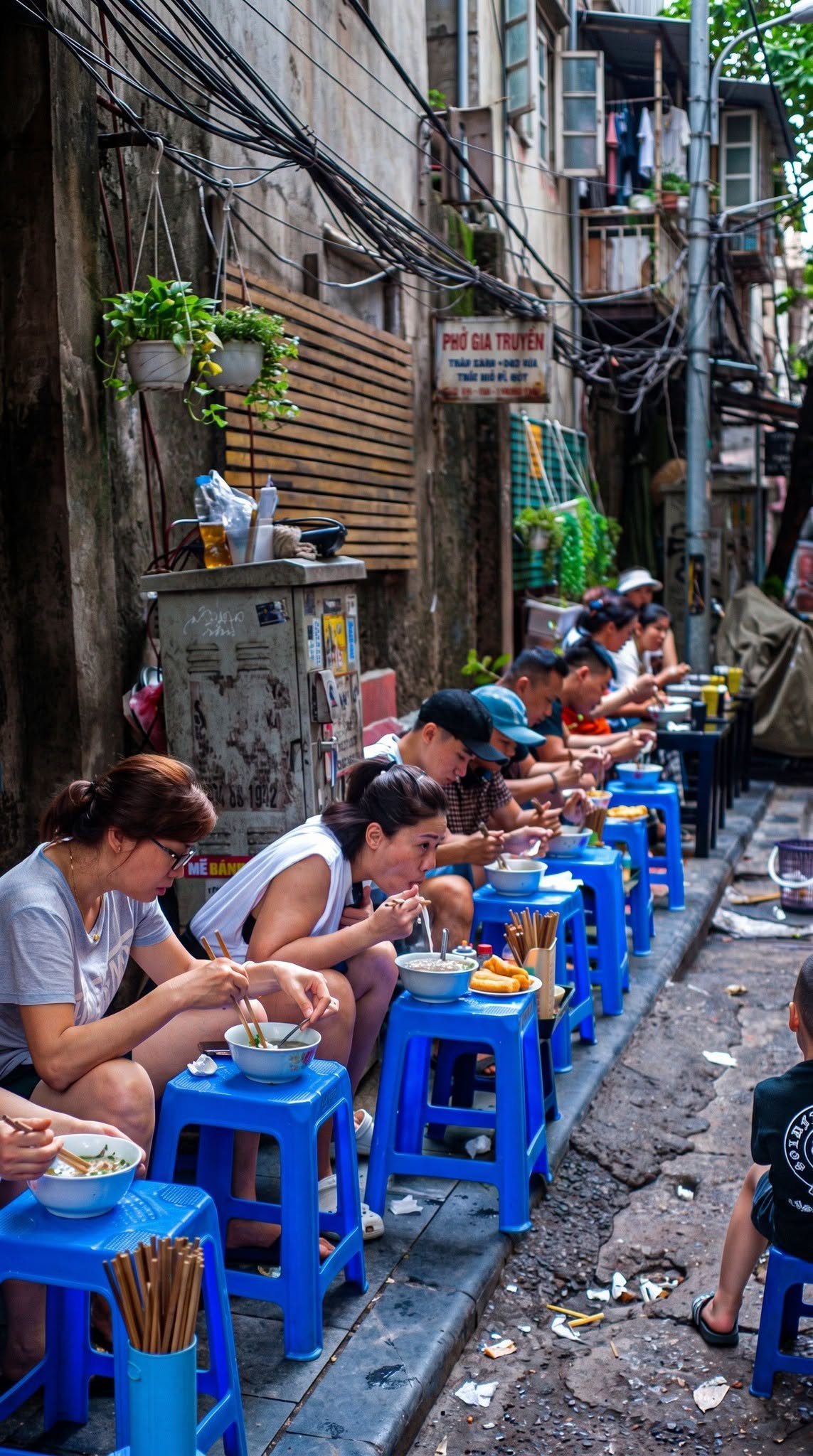
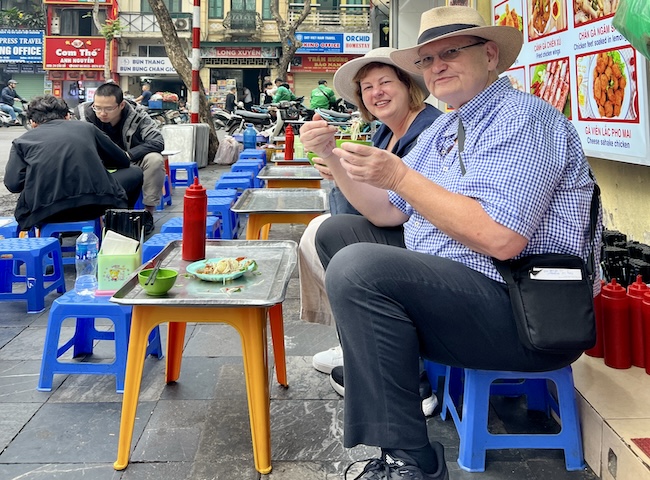
Your seat is a tiny plastic stool, approximately the size of a large lunchbox. Your knees are almost touching your chin, your feet are awkwardly positioned, and the table in front of you is so low that you briefly wonder whether you've accidentally booked a meal in a kindergarten.
Welcome to Vietnam!
Here, some of the best meals don't come with comfortable chairs, elegant table settings or air-conditioned dining rooms. They come with steaming bowls of noodles, sizzling pans, busy pavements and little plastic stools that seem to have been designed for people with extremely flexible knees.
And surprisingly, once you get used to them, you might discover that these tiny seats are one of the most charming parts of Vietnamese food culture.
Your First Challenge: Actually Sitting Down
The first encounter with a Vietnamese plastic stool can be a surprisingly athletic experience.
You approach confidently, assuming sitting down will be easy. After all, it's just a chair, right?
Wrong.
You lower yourself carefully, trying to maintain your dignity while your knees rise towards your chest. If you're particularly tall, the experience can feel less like sitting down for dinner and more like folding yourself into a suitcase.
Some stools are so low that getting back up requires a little planning. You might need to push against the table, find your balance and hope nobody is watching.
But here's the funny thing: Vietnamese diners seem completely comfortable with this arrangement.
They sit, eat, chat, drink iced tea and enjoy their meals as if they're sitting in expensive dining chairs.
Meanwhile, the foreign visitor is still negotiating with a piece of plastic.
Give it a few days, though, and something strange happens. You stop noticing the stool. You become more interested in the food, the atmosphere and the lively little world happening around you.
That's when the real street-food experience begins.
Why Are Vietnamese Street-Food Stools So Small?
 The answer is partly practical.
Vietnamese cities, particularly older urban neighbourhoods, are full of narrow streets, small shopfronts and busy pavements. Many food businesses operate from compact spaces, sometimes with only a few square metres available.
Large dining tables and heavy chairs would take up valuable room. They would also be difficult to move around when the pavement needs to accommodate pedestrians, parked motorbikes and customers coming and going.
Small plastic stools solve several problems at once.
They're cheap, lightweight, easy to clean and simple to stack. When a food stall closes, the owner can collect dozens of them and store them in a relatively small space.
When customers arrive, the stools appear almost magically.
One minute, the pavement is empty. The next, it has become a restaurant.
Some vendors even use the stools as temporary tables, placing a tray or another flat surface on top. Others simply arrange them around a low table.
It's a wonderfully flexible system.
Of course, there is another advantage: if your restaurant furniture costs less than your bowl of seafood noodles, you probably don't need to worry too much about someone accidentally scratching it.
The Pavement Is Not Just a Place to Walk
In many countries, pavements are mainly designed for pedestrians. In Vietnam, particularly in busy neighbourhoods, they can serve several purposes at once.
They're walking spaces, parking areas, small business locations and, in many places, outdoor dining rooms.
A typical street-food scene might include a vendor preparing bowls of pho, customers sitting on low stools, a motorbike passing nearby and someone delivering a basket of fresh herbs.
There may be a fruit seller at the next shop, a coffee stall around the corner and a delivery driver trying to squeeze through a narrow gap.
Everything happens together.
For someone used to quiet indoor restaurants, the atmosphere can be overwhelming at first. There's no obvious separation between the kitchen, dining area and street.
But that's part of the appeal.
You can watch your food being prepared, hear the vendor calling out orders and see the ingredients being added right in front of you.
The street becomes part of the dining room.
Of course, pavement dining varies from place to place, and not every Vietnamese restaurant operates this way. Larger restaurants, shopping centres and modern cafés offer more conventional seating.
But in many neighbourhoods, especially where traditional food stalls remain popular, the tiny plastic stool is still a familiar sight.
A Tiny Stool, A Very Big Menu
 One of the best things about Vietnamese street food is that a humble little stool can lead you to an enormous variety of dishes.
You might sit down for a bowl of phở, Vietnam's famous noodle soup, served with fragrant broth, rice noodles, herbs and beef or chicken.
Or perhaps you'll find bún chả, a Hanoi favourite featuring grilled pork, rice noodles, fresh herbs and a bowl of dipping sauce.
If you prefer something crispy, there's bánh xèo, a golden Vietnamese pancake filled with ingredients such as pork, shrimp and bean sprouts.
And then there's bánh mì, the famous Vietnamese sandwich that has managed to turn a humble baguette into an international food celebrity.
Some stalls specialise in just one dish. Others have a surprisingly long menu despite having a kitchen that looks smaller than a wardrobe.
You may also notice that people don't necessarily stay for long.
A customer arrives, orders a bowl of noodles, eats, pays and leaves. Another customer takes the same seat almost immediately.
The little stools make this arrangement easy. They encourage a casual, flexible style of dining rather than the long, formal restaurant experience.
It's less about sitting comfortably for three hours and more about enjoying something delicious before getting on with your day.
Although, if the food is particularly good, you might decide that getting on with your day can wait.
The Art of Eating While Everything Happens Around You
Vietnamese street food is not just about the dish itself. It's also about the atmosphere.
Imagine sitting at a small stall in Hanoi in the morning.
A pot of broth is bubbling nearby. The vendor is arranging bowls, chopping herbs and preparing orders. Motorbikes move through the street, people stop to buy breakfast, and someone at the next table is already halfway through a bowl of noodles.
You can smell grilled meat, fresh herbs and coffee mixing in the air.
A stranger might sit beside you, even though you have never met. Nobody seems particularly concerned about personal space. If there's an empty stool, it's probably going to be used.
Sometimes you might find yourself sharing a table with complete strangers. A few words may be exchanged, or everyone may simply concentrate on their food.
There's a certain friendliness in this casual arrangement.
People don't need a reservation, a dress code or a special occasion to enjoy a meal together. They simply show up, find a seat and eat.
And the best part? You don't have to pretend to understand a complicated menu.
If you see a dish that looks delicious at the next table, you can simply point at it and ask what it is.
Food recommendations don't always need an online review. Sometimes the most useful restaurant guide is the person sitting two stools away.
From Practical Furniture to a Cultural Icon
The little plastic stool has become so closely associated with Vietnamese street life that it often appears in travel photographs, documentaries and stories about the country's food culture.
But it isn't simply a decorative symbol.
Its popularity reflects the way many Vietnamese cities have developed around small businesses, family-run food stalls and informal outdoor spaces.
For generations, food vendors have served local residents from modest premises, using available space creatively.
The stools are part of that practical tradition.
They're also affordable, which matters for small businesses. A vendor can serve several customers without investing in expensive furniture or renting a large dining room.
This doesn't mean every street-food business is informal or that every pavement is automatically available for commercial use. Local rules about sidewalk use vary, and urban authorities regularly manage pedestrian access and street order.
But the visual connection between plastic stools and Vietnamese street food remains strong.
In fact, you could argue that the stool is almost as recognisable as the bowl of pho sitting on top of the table.
Almost. Let's not get carried away. Nobody travels halfway around the world just to photograph a plastic chair.
Or do they?
A Few Tips for Your First Plastic-Stool Adventure
If you're visiting Vietnam and want to try the local street-food experience, here are a few simple suggestions.
1. Don't judge the restaurant by its furniture.
Some excellent street-food stalls have very basic seating. A tiny stool doesn't automatically mean the food is poor. Look for places with fresh ingredients, good food-handling practices and a steady flow of customers.
2. Watch how local customers order.
Some stalls have a menu, while others specialise in one or two dishes. If you're unsure, observe what people are eating and ask the vendor for recommendations.
3. Bring a little flexibility — literally.
If you're tall or not used to sitting low, you may find the seating uncomfortable. Choose a spot that gives you enough room, and don't feel obliged to stay if it doesn't suit you.
4. Carry some cash.
Many small food stalls accept cash, although mobile payments and bank transfers are becoming increasingly common in Vietnam.
5. Enjoy the atmosphere.
Don't spend the entire meal looking at your phone. Watch the food being prepared, listen to the sounds of the street and enjoy the little details.
And please don't attempt to balance a full bowl of hot pho on your lap while trying to take a photograph. Your clothes will not thank you.
So, Is the Tiny Plastic Stool Worth Trying?
Absolutely — provided your knees are willing to cooperate.
Vietnamese street food is about much more than what appears in the bowl. It's about the people who prepare it, the streets where it's served and the everyday rhythm of city life.
The little plastic stool represents a simple, practical way of bringing people together. It doesn't need to be beautiful, expensive or particularly comfortable.
It just needs to hold you long enough to finish your noodles.
And perhaps that's the secret of its charm.
You might arrive in Vietnam expecting to discover famous dishes, beautiful landscapes and fascinating cultural traditions. But somewhere along the way, you may find yourself remembering something much smaller: a crowded pavement, a delicious bowl of food and a tiny blue plastic stool that somehow became your favourite restaurant seat.
Just remember one thing before you sit down.
Check that the stool is facing the right way, make sure all four legs are on the ground, and prepare yourself for the journey back to standing.
Because in Vietnam, even having dinner can come with a little workout!