
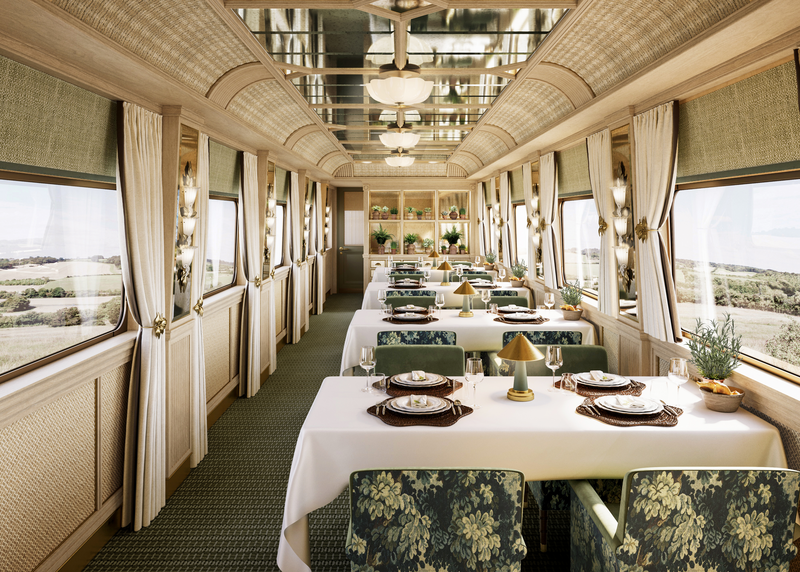






Imagine arriving at a railway station, climbing aboard an old train carriage and sitting down for a meal. You expect the usual restaurant experience: a menu, a waiter and perhaps a little background music.
But then you look around. The wooden interiors, vintage details and narrow windows make you feel as though you've travelled back almost a century. Outside, the mountains of the Spanish Pyrenees stand quietly in the distance.
And no, the train isn't about to leave. You're here to eat.
Welcome to Canfranc Express, one of Spain's most unusual fine-dining restaurants, tucked inside a beautifully restored historic railway carriage at Canfranc International Station. With a Michelin star and a menu inspired by the culinary traditions of Aragón, this is a place where railway history and modern gastronomy share the same table.
It's also proof that sometimes the journey really is the destination — even when the train doesn't move an inch.
A Railway Station Built for a Grand European Journey
Before talking about the food, let's take a moment to appreciate the extraordinary building that houses this restaurant.
Canfranc International Station stands in the Spanish Pyrenees, close to the French border. Surrounded by mountains, forests and dramatic scenery, it looks like the sort of place where an adventure should begin.
And that was precisely the idea.
The station officially opened on 18 July 1928, with King Alfonso XIII of Spain and President Gaston Doumergue of France attending the inauguration. It was designed to connect the railway networks of the two countries through the difficult mountain landscape.
At the time, it was an ambitious engineering and transport project. The station was enormous, with a grand architectural design that seemed almost too impressive for its remote mountain location.
Its long façade, large windows and elaborate interior gave it the appearance of a palace rather than an ordinary railway station.
Imagine arriving there with a suitcase, a ticket to France and absolutely no idea what awaited you on the other side of the mountains. It must have felt rather glamorous.
Of course, modern travellers might have been more concerned about whether the train had Wi-Fi.
From International Gateway to Forgotten Railway Giant
 Canfranc Station was built to be an important European transport hub, but its history was far from smooth.
For decades, trains carried passengers and goods between Spain and France. The station witnessed an extraordinary mix of travellers, railway workers and border officials.
Its location also placed it in the middle of some dramatic historical events.
During the Second World War, Canfranc became an important border crossing. The area saw the movement of refugees, goods and people trying to escape the conflict. The station has also become associated with stories of espionage and clandestine activity, making its past particularly fascinating.
But the railway's fortunes eventually declined.
In 1970, a railway bridge on the French side was damaged in an accident, interrupting international train services. The cross-border connection never returned to its former role, and the station gradually fell into disuse.
For years, the grand building stood as a reminder of a railway dream that had been interrupted.
Fortunately, its story didn't end there.
The station underwent an extensive restoration and reopened in a new chapter of its life as Canfranc Estación, a Royal Hideaway Hotel. Its historic character was preserved while the building was transformed into a luxury destination.
And among the most unusual attractions inside this revived railway landmark is a restaurant that gives its old carriages a delicious second life.
All Aboard the Canfranc Express!
The Canfranc Express restaurant is located inside a restored historic train carriage.
Rather than building a restaurant that merely imitates the appearance of an old train, the team has used the real railway setting to create an experience that feels connected to the station's past.
The carriage has been carefully refurbished, preserving its vintage atmosphere while introducing the comfort and elegance expected of a high-end restaurant.
There are only three exclusive tables in the gourmet dining space, making the experience particularly intimate. Booking well in advance is therefore important.
The Michelin Guide describes the experience as a journey through the station's history, beginning with historical details on the platform and including an aperitif stop in the neighbouring 1928 restaurant carriage.
That second carriage is worth mentioning because it has its own identity. The restaurant 1928 offers a different dining experience, with a stronger French influence and a setting inspired by the luxury trains of the 1920s.
So, if you're planning a visit, don't confuse the two. Canfranc Express and 1928 are closely connected, but they are separate restaurant experiences.
The whole arrangement sounds rather wonderful: a little railway history, an aperitif, and then a carefully prepared meal inside a carriage that has witnessed a very different era of travel.
Just don't rush to the door when you hear a noise outside. Your train isn't necessarily leaving without you.
A Michelin-Starred Journey Through Aragón
Of course, a beautiful railway carriage alone cannot guarantee a memorable meal. Fortunately, Canfranc Express has something more substantial to offer.
The restaurant is led by chef Eduardo Salanova, who was born in Canfranc. His cooking is closely connected to the region's culinary traditions, particularly the ingredients and recipes of Aragón.
The idea is to take familiar regional flavours and reinterpret them using contemporary techniques.
Rather than simply reproducing traditional dishes, the kitchen explores how local ingredients can be presented in new ways while retaining their original character.
The surrounding Pyrenees provide plenty of inspiration. The region is known for its mountain produce, meats, vegetables, cheeses and other ingredients shaped by its landscape and climate.
The menu changes with the seasons, highlighting products from the local area and reflecting the culinary heritage of Aragón.
There are also French influences, which make perfect sense given the restaurant's location so close to the border. For centuries, the mountain valleys on both sides have shared connections through trade, travel and food.
One dish might draw inspiration from a traditional Aragonese recipe, while another reflects techniques or flavours associated with French cuisine.
It's almost as if the chef has decided to recreate the old international railway connection — except this time, the passengers travel between flavours rather than countries.
The restaurant received its first Michelin star in 2023, recognising the quality and creativity of its gastronomic offering.
And unlike a conventional restaurant where you might order one main course and head home, Canfranc Express focuses on a tasting-menu experience. Expect a sequence of carefully prepared courses rather than one enormous plate of food.
If you're the kind of person who likes to know exactly what you're eating, this is also a chance to discover regional ingredients you might never have encountered before.
The Romance of Old-Fashioned Train Travel
There is something special about old trains that modern transport rarely manages to reproduce.
Today's journeys are often about efficiency. We check departure times, find our seats, put on headphones and stare at our phones until we reach our destination.
But railway travel in the early 20th century had a different atmosphere.
Long-distance journeys could last many hours or even days. Dining cars were an important part of the experience, offering passengers a place to eat, relax and meet fellow travellers.
Elegant dining rooms, polished wooden furniture, carefully arranged tables and attentive service helped turn travelling into an occasion.
Luxury trains became symbols of adventure and sophistication. A journey across Europe was not simply about reaching another city; it was an experience in itself.
Canfranc Express captures a little of that atmosphere.
The old carriage invites guests to slow down and appreciate the details. Instead of rushing through lunch, you can enjoy the setting, the food and the story behind the building.
And perhaps that's what makes the restaurant so appealing. It offers something increasingly rare: the feeling that time has slowed down.
Well, at least until you remember you still have emails waiting for you.
Is It Worth Taking a Trip Just to Eat Here?
Let's be realistic. Canfranc Express is not an everyday restaurant for someone looking for a quick and affordable lunch.
It's a luxury gastronomic experience, and its Michelin-starred status, exclusive seating and carefully prepared tasting menu place it firmly in the special-occasion category.
But the restaurant offers something that is difficult to reproduce elsewhere.
You aren't simply paying for a meal in an attractive room. You're experiencing a piece of railway history, surrounded by the landscape that once made this station such an ambitious international project.
It's particularly appealing if you enjoy several things at once: unusual restaurants, historic architecture, railway heritage and creative regional cuisine.
And even if you're not planning to dine at Canfranc Express, the station itself is worth discovering. Its dramatic architecture and mountain setting make it an extraordinary destination for anyone interested in European railway history.
One practical point: this is an exclusive restaurant with limited seating, so check its current opening arrangements and reserve ahead through the hotel. The restaurant operates seasonally, and availability can change.
A Final Ticket to the Past
Canfranc Express is a reminder that old places don't always need to become museums to preserve their history.
Sometimes, they can find a completely new purpose.
A railway carriage that once carried travellers through the mountains now welcomes guests for a Michelin-starred meal. A station that once connected two countries has become a destination in its own right. And the culinary traditions of Aragón are being introduced to visitors through a rather unusual dining experience.
Would I recommend travelling all the way to the Spanish Pyrenees just to eat inside an old train carriage? If you love food, history and beautiful places, it's certainly worth considering.
After all, most restaurants ask you to come inside and take a seat.
Canfranc Express invites you to climb aboard.
And the best part? You don't have to worry about missing your stop. The dessert will arrive right at your table.