
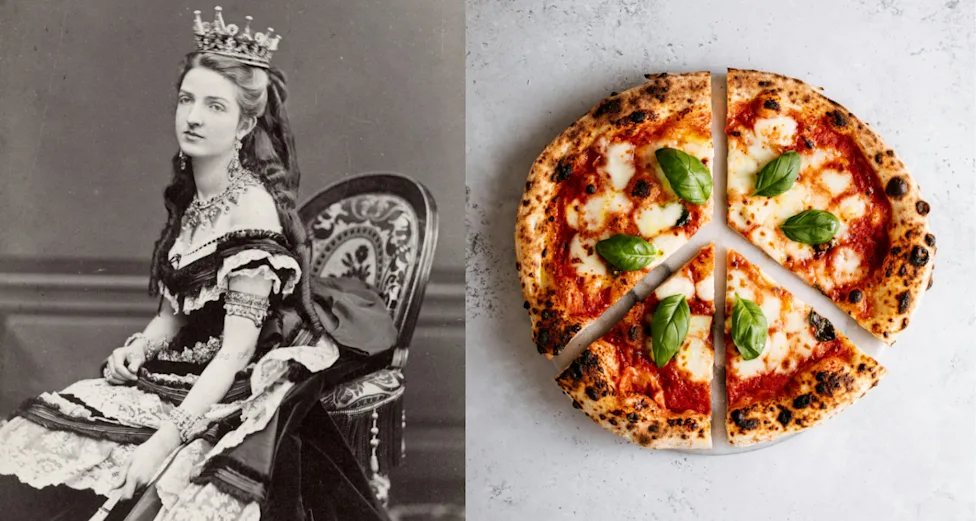






Imagine inventing one of the world’s most famous pizzas, naming it after a queen, and becoming a permanent part of food history.
Sounds like a pretty good career move, right?
According to one of Italy’s most beloved food legends, that is exactly what happened in Naples in 1889. A pizza maker named Raffaele Esposito supposedly prepared three pizzas for Queen Margherita of Savoy. One featured tomatoes, mozzarella, and fresh basil—the red, white, and green of the Italian flag. The queen loved it so much that Esposito named it Pizza Margherita in her honor.
And just like that, a humble pizza allegedly received the royal treatment.
It is a charming story. It has royalty, national pride, a talented chef, and a delicious happy ending. Hollywood could probably stretch it into a two-hour film, complete with dramatic violin music and a close-up of melting mozzarella.
There is just one little problem: the story may not be entirely true.
Before we cancel the queen’s pizza party, though, let’s look at what really happened—and why the truth behind this famous slice is more complicated than a menu description suggests.
1. The Royal Pizza Party of 1889
Let’s start with the classic version of the story.
In June 1889, King Umberto I and Queen Margherita visited Naples. The city had a strong culinary identity, and pizza was already a familiar local food. According to tradition, the royal couple wanted to try something different from the elaborate dishes usually served at court.
Enter Raffaele Esposito, a well-known local pizza maker associated with a pizzeria later known as Pizzeria Brandi.
The story says Esposito was invited to prepare pizzas for the queen. He allegedly made three varieties, including one topped with tomatoes, mozzarella, and basil. Its colors conveniently matched the Italian flag:
- Red: tomatoes
- White: mozzarella
- Green: basil
The queen supposedly preferred this combination, and Esposito named it after her.
It was a brilliant story from a marketing perspective. A popular local dish had apparently won royal approval, and an ordinary pizza maker had earned a place in culinary history.
Imagine the advertisement: “Approved by Her Majesty!”
Today, that would probably be printed on the menu in gold lettering, accompanied by a photograph of a smiling queen and a pizza with an unnecessarily dramatic cheese pull.
But did the royal encounter really happen exactly as described? That is where things get interesting.
2. The Pizza Existed Before the Queen Got Involved
Here is the first twist: tomatoes, mozzarella, and basil were not a revolutionary combination invented for Queen Margherita.
Historical descriptions of Neapolitan pizza show that similar toppings were being used decades before the famous royal visit.
In an 1853 collection about Neapolitan customs, writer Emanuele Rocco described pizzas topped with ingredients including basil, mozzarella, and tomatoes. The Association of True Neapolitan Pizza also acknowledges that the ingredients associated with Margherita-style pizza appeared in earlier pizzas.
That means the queen could not have been the reason the basic combination first came into existence.
Think of it this way: imagine someone telling you they invented peanut butter and banana sandwiches because a celebrity once ate one at their house. Then you discover that people had been eating the same combination for years.
The celebrity may have enjoyed it. The host may even have served it. But inventing it? That is a much bigger claim.
The same distinction matters here. A royal visit might have helped popularize a pizza or attach a famous name to it, but that is different from inventing the dish itself. The available historical evidence does not establish exactly how the name originated.
3. So, Did the Queen Even Eat the Pizza?
This is where historians start asking awkward questions—rather like guests who arrive at a dinner party and begin inspecting the receipts.
The royal couple’s visit to Naples in 1889 is part of the historical record. Raffaele Esposito was also a real pizza maker. However, researchers have raised doubts about the famous story of the queen tasting his pizzas and sending him a thank-you letter.
One key piece of evidence is a letter traditionally presented as confirmation that the royal household enjoyed Esposito’s food.
The letter is said to have come from Camillo Galli, who worked in the royal household. But historians examining the story have pointed out problems with the document, including differences between the signature attributed to Galli and examples of his handwriting. They have also noted the absence of independent contemporary reports confirming the celebrated pizza tasting.
National Geographic’s investigation into the legend discusses these inconsistencies and the possibility that the story was embellished or promoted later to benefit the pizzeria.
Does this prove that Queen Margherita never tasted a pizza made by Esposito? Not conclusively. Missing records do not automatically prove that an event never happened.
But it does mean we should be careful about repeating the story as established fact.
The fairest verdict is that the royal-pizza tale remains disputed. The queen’s visit happened; the precise pizza-making episode and the evidence used to support it are much less certain.
History, unfortunately, does not always come with a security-camera recording.
4. Why Would Anyone Invent Such a Story?
If the tale was exaggerated, why would anyone bother?
The answer may be less mysterious than the plot of a detective novel: a good story sells pizza.
A simple flatbread topped with tomato, cheese, and basil is delicious, but “a traditional Neapolitan pizza” does not have quite the same dramatic sparkle as “the pizza personally loved by an Italian queen.”
The royal connection gives the dish a memorable origin story. It turns lunch into a little piece of history and makes a familiar combination sound special.
National identity may also have played a role in the story’s appeal. In the decades following Italian unification, the national flag and the new kingdom carried political significance. A pizza featuring red, white, and green ingredients made a neat symbol of Italian identity.
The legend therefore has everything needed to survive: a queen, a national symbol, an ordinary artisan, and a dish loved around the world.
Some researchers have suggested that the story was promoted by people associated with the pizzeria in later decades. That remains an explanation proposed by historians, rather than a definitively proven account of who created the legend.
Still, it is easy to understand why the story caught on.
If you owned a pizzeria and had the choice between saying, “Our recipe is very old,” and “Our recipe once delighted royalty,” which one would you put on the sign?
Exactly. Even in the nineteenth century, people understood the power of a good headline.
5. Naples Had a Pizza Culture Long Before 1889
Focusing too much on the queen also risks overlooking the real history of pizza in Naples.
Pizza was not waiting around for a royal guest to discover it. It was already part of everyday life in the city, especially among ordinary people who needed food that was affordable, filling, and easy to eat.
Historical accounts describe pizza being sold in the streets and prepared with ingredients that varied according to local customs, availability, and budget. Some versions featured garlic and oil; others included cheese, herbs, tomatoes, or fish.
In the nineteenth century, pizza was often associated with working-class Neapolitan life. Street vendors sold portions to people who wanted a quick, inexpensive meal. It was practical food, not necessarily the elegant restaurant dish many people imagine today.
The modern idea of pizza as an international favorite came much later, through migration, changing tastes, and the spread of pizzerias beyond Naples and Italy.
Italian migrants carried their food traditions abroad, helping pizza develop into the many regional and international styles we know today.
So while the queen makes an excellent character in the story, she was not the beginning of pizza history.
She was, at most, one possible chapter in a much longer tale.
6. What Makes a Real Neapolitan Margherita?
Whether or not the queen inspired the name, the classic Margherita remains a celebration of simplicity.
Its traditional toppings are tomato, mozzarella, fresh basil, salt, and olive oil. That sounds almost suspiciously uncomplicated in a world where pizzas can arrive covered in everything from truffle oil to ingredients that require a small loan.
But simplicity is precisely the point.
The tomato provides sweetness and acidity. Mozzarella brings a creamy texture. Basil adds freshness, while olive oil ties everything together. A properly made Neapolitan pizza also depends on its dough, fermentation, shaping, and baking—not just the ingredients scattered on top.
The result should be soft and tender, with a puffed edge and a center that remains moist rather than turning into a rigid cracker.
And yes, the colors are beautiful. The red, white, and green look like the Italian flag, which helps explain why the national-symbol story is so appealing.
However, it is worth remembering that a dish can represent a country without having been invented specifically to do so.
The pizza does not need a royal birth certificate to be delicious.
7. The Queen Was Not the Only Reason Pizza Became Famous
There is another important detail: the legend can make pizza’s rise to fame sound like a single magical moment.
In reality, food rarely becomes popular because one important person takes a bite.
Pizza’s international success depended on many factors: migration, urban life, changing food habits, restaurants, and the ability of the dish to adapt to local ingredients and preferences.
Italian communities helped introduce pizza to new audiences. Over time, different places developed their own versions. Some became famous for thin, crisp crusts; others favored thicker bases, generous toppings, or completely different baking methods.
The Margherita survived all these changes because it is adaptable and easy to love. It is also a useful test of a pizzeria’s basic skills: with relatively few toppings, there is nowhere for poor dough or unbalanced flavors to hide.
In other words, the queen may have helped make the story memorable, but generations of pizza makers and hungry customers helped make pizza a global favorite.
That is a much bigger achievement than one royal dinner.
8. So, Did Queen Margherita Really Inspire Pizza Margherita?
Here is the most honest answer: we cannot say for certain.
The traditional account says that Raffaele Esposito served the queen a pizza topped with tomato, mozzarella, and basil in 1889, then named it after her. The tale remains popular and is still repeated by food historians, pizzerias, and tourism sources.
But earlier descriptions show that the ingredients already existed together on pizza. Questions have also been raised about the famous thank-you letter and the lack of independent contemporary evidence for the alleged tasting.
The evidence therefore challenges the idea that Esposito invented the pizza specifically for the queen. It does not allow us to reconstruct every detail of what she may or may not have eaten.
Perhaps the name became attached to an existing style of pizza. Perhaps the royal connection was embellished over time. Or perhaps a real encounter inspired a story that later grew more polished with each retelling.
The surviving evidence does not settle the question completely.
And that is fine. Food history is full of stories that sit somewhere between documented fact and popular tradition.
The important thing is to know the difference.
The Final Slice
The next time you order a Pizza Margherita, you can enjoy it without imagining that every bite has royal approval.
The queen may have tasted it. She may have helped inspire its famous name. Or the story may have become more glamorous as it passed from one generation to the next.
What we do know is that Neapolitan pizza had a history before 1889, and the tomato-mozzarella-basil combination was not a brand-new invention created for a royal visitor.