






Most of us have experienced the struggle of eating a burger that is just a little too big. You take one bite, the lettuce escapes, the sauce lands on your shirt, and somehow the entire bottom bun gives up on life.
Now imagine a hamburger weighing more than 1.1 tonnes.
That's not a lunch. That's a construction project with cheese.
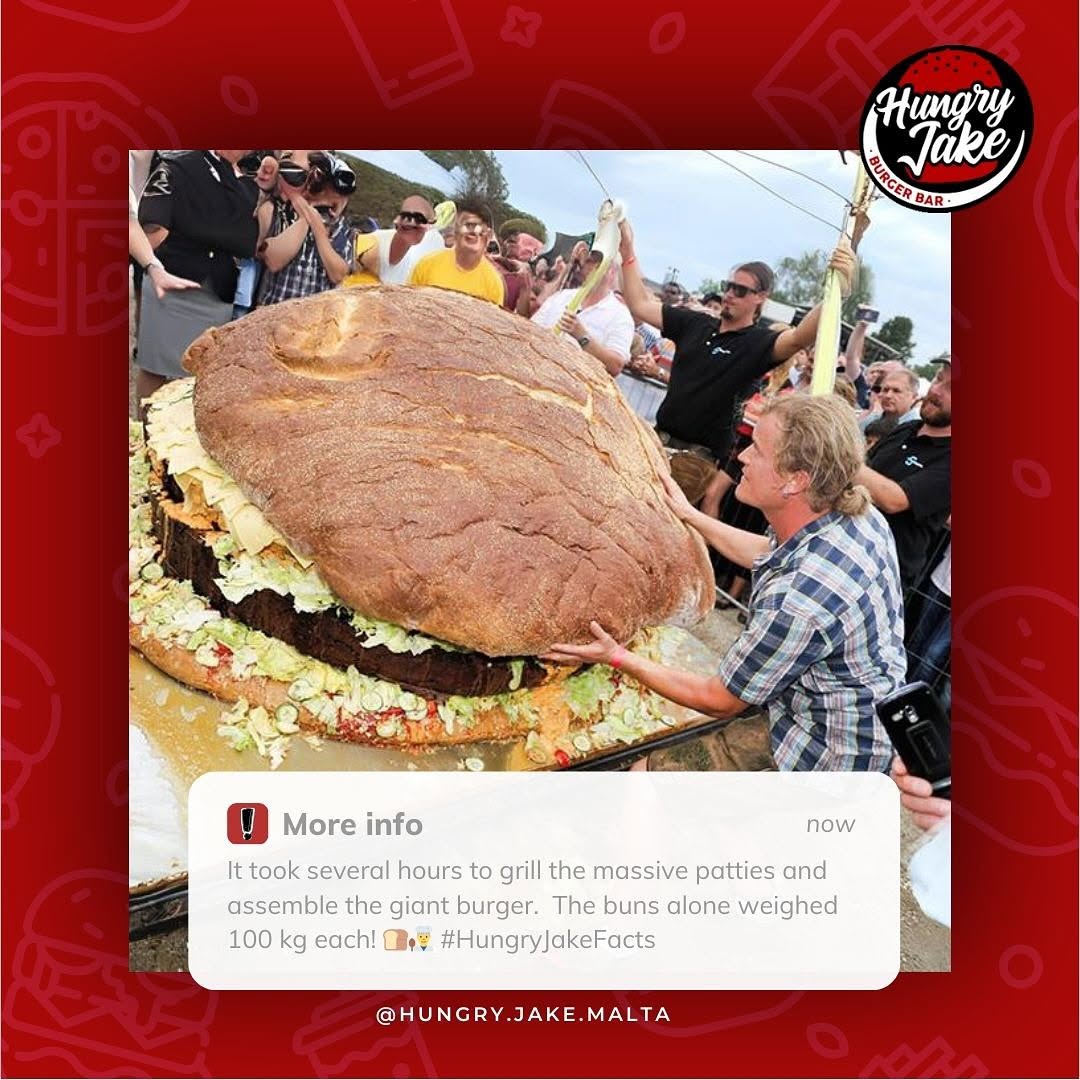
In 2017, a group of six German men created the world's largest hamburger in Pilsting, Germany. Their creation weighed an incredible 1,164.2 kg (2,566 lb 9 oz), earning an official Guinness World Records title.
To put that into perspective, you could invite an entire neighbourhood to dinner and still have a burger large enough to make your kitchen look completely inadequate.
But how do you actually make something like that? Who cooks it? How do you weigh it? And, most importantly, what happens when everyone has finished taking photographs?
Let's take a closer look at the delicious madness behind the world's biggest burger.
The Burger That Needed a Team, Not a Chef
The record-breaking burger was created by six German friends: Wolfgang Leeb, Tom Reicheneder, Rudi Dietl, Josef Zellner, Hans Maurer and Christian Dischinger.
They presented their enormous creation at a public event in Pilsting on 9 July 2017.
Their goal was simple: make a hamburger big enough to break the existing world record.
Well, "simple" might not be the right word.
Making a normal burger requires a frying pan, some ingredients and perhaps a little patience. Making a burger weighing over a tonne requires serious planning, specialist equipment and a team of people who probably don't panic when someone asks them to cook dinner for 2,000 guests.
The finished burger contained multiple layers of meat, vegetables, cheese and sauce, held together by enormous buns.
Guinness officially recorded its weight at 1,164.2 kg.
That's roughly the weight of a small car — except this one comes with ketchup.
First Problem: Where Do You Even Find a Bun That Big?
Let's start with the bread.
A regular burger bun can fit comfortably in your hands. A bun for a tonne-sized hamburger is an entirely different matter.
You can't simply visit the nearest bakery and ask for a slightly larger sesame bun. The baker might politely suggest that you try the next industrial estate.
The two enormous buns needed to support the burger's layers had to be made specifically for the project.
They also had to be strong enough to hold a huge amount of filling without collapsing under the weight.
This is an important detail. A giant burger isn't just a normal burger enlarged in a photo-editing programme. Every ingredient has to work together, and the structure has to survive the cooking and assembly process.
Imagine spending days preparing the world's biggest burger, only to watch the bottom bun collapse like a disappointed pancake.
That would be a very expensive sandwich disaster.
The Meat: A Whole Lot of Beef
Of course, the most important part of a traditional hamburger is the meat.
The 2017 record-breaker contained an enormous amount of beef, arranged in multiple layers. The Guinness record description refers to three meat patties, alongside tomatoes, lettuce, cucumbers, onions, hamburger sauce and a giant bun.
The ingredients had to be prepared and cooked on a scale far beyond an ordinary restaurant kitchen.
Cooking such a large quantity of meat presents a serious challenge. Heat needs to reach the centre, and the team must make sure the food is properly cooked rather than simply looking impressive on the outside.
A normal burger can be turned with a spatula. A giant burger is a different story.
You need a cooking arrangement designed for the job, careful coordination and a way to manage the enormous components safely.
In other words, this is not the moment to shout, "Quick, flip it before it burns!"
The Real Challenge: Building a Burger Without Destroying It
Once the ingredients are ready, the next challenge is assembly.
A burger is usually built from the bottom up: bun, patty, cheese, vegetables, sauce and top bun.
Easy enough when everything fits on a plate.
But when the burger becomes enormous, every layer adds weight. The ingredients must be positioned carefully, and the whole structure needs to remain stable.
There's also the problem of presentation. A world-record burger has to look like a burger, not a pile of ingredients that accidentally fell off a delivery truck.
The organisers had to coordinate the cooking and assembly so that the final creation could be presented and weighed as one giant hamburger.
And let's not forget the photographs. When you've created something that weighs more than a tonne, you definitely want photographic evidence.
How Do You Weigh a Hamburger That Weighs More Than a Ton?
This might be the most surprising part of the entire project.
You can't put a 1,164 kg burger on your bathroom scales. Even if you had the patience to try, your bathroom would probably never forgive you.
For a Guinness World Records attempt, the weight must be established using suitable weighing equipment and verified according to the record's requirements.
The burger's final weight was officially recorded at 1,164.2 kg.
That decimal point matters. Guinness doesn't award records based on how impressive something looks in a photograph.
The organisers must provide evidence that the achievement meets the rules, including the required measurements and documentation.
So, while the crowd sees a gigantic burger, the record team sees a rather serious measurement exercise.
Somewhere, a calculator is having the busiest day of its life.
What Happens to a Burger That Big?
Now comes the question that really matters.
After all the effort, ingredients and equipment, what do you do with a hamburger weighing more than 1,000 kg?
You certainly can't put it in a takeaway box.
Fortunately, the event wasn't just about creating a giant object for photographs. The burger was intended to be shared with the public.
Reports from the event describe thousands of visitors attending the celebration. After the record was confirmed, the enormous burger was divided into smaller portions and served to people at the event.
One report described around 20 helpers cutting it into nearly 3,000 portions, which were sold to visitors. The event also raised money for local causes.
Think about that for a moment: nearly 3,000 people could enjoy a piece of the same hamburger.
That's quite a family meal.
And the organisers had to think about food handling, serving arrangements and distribution — because a giant burger is only impressive if people can actually eat it.
Not All Giant Burgers Are Created Equal
The German burger wasn't the only enormous hamburger to attract attention.
There have been several other record-breaking creations, although it's important to distinguish between different categories.
For example, the largest hamburger commercially available is a separate record from the largest hamburger ever made.
In 2011, Juicys Outlaw Grill in Corvallis, Oregon, offered a burger weighing 352.44 kg (777 lb). It was available to order for $5,000, with 48 hours' notice.
That's an expensive burger, but at least you wouldn't need to worry about running out of food at a family gathering.
Another famous giant burger was made by Mallie's Sports Grill & Bar in Michigan. Its enormous cheeseburger weighed around 816 kg (1,794 lb) and was reported as a commercial menu item.
The restaurant's project involved a custom-built grill, a giant bun and hundreds of kilograms of ingredients.
These examples show why record categories matter. A burger made for a one-day record attempt isn't necessarily the same as one that customers can order from a restaurant menu.
And if you ever see a headline claiming that someone has made the world's biggest burger, it's worth checking exactly which category the record belongs to.
Otherwise, you might end up comparing a giant homemade burger with something a restaurant actually sells — which is a bit like comparing a homemade birthday cake with an entire wedding cake factory.
Why Do People Make Food This Ridiculously Big?
It's a fair question.
Nobody genuinely needs a burger weighing more than a tonne. Even the hungriest person at a family barbecue would probably surrender after a few bites.
But giant food records aren't really about satisfying hunger.
They're about creativity, engineering, teamwork and the excitement of attempting something extraordinary. They also bring communities together through public events, celebrations and shared experiences.
There's something entertaining about watching ordinary food transformed into something completely absurd.
A burger becomes a spectacle. A cooking challenge becomes a community event. And a group of friends gets to tell people for the rest of their lives that they once made a hamburger heavier than a car.
Not a bad conversation starter.
Of course, there is an important responsibility that comes with these events: planning how food will be handled and distributed so that as little as possible goes to waste.
After all, nobody wants the world's biggest burger to become the world's biggest leftover problem.
Would You Actually Eat It?
The world's largest hamburger is an impressive achievement, but I suspect most people would be perfectly happy with a normal-sized burger.
There's something wonderfully ridiculous about the idea of making a sandwich so large that it needs specialist equipment, a team of helpers and an official weighing process.
It also reminds us that food can be more than something we eat. Sometimes it becomes entertainment, a technical challenge and a reason for an entire community to gather.
So, the next time you complain that your burger is too big to fit in your mouth, spare a thought for the people who created a 1,164.2 kg monster.
And remember: if your burger requires a construction plan, industrial equipment and thousands of hungry guests, you may have gone slightly beyond the definition of fast food.
Bon appétit — and good luck finding a plate!