
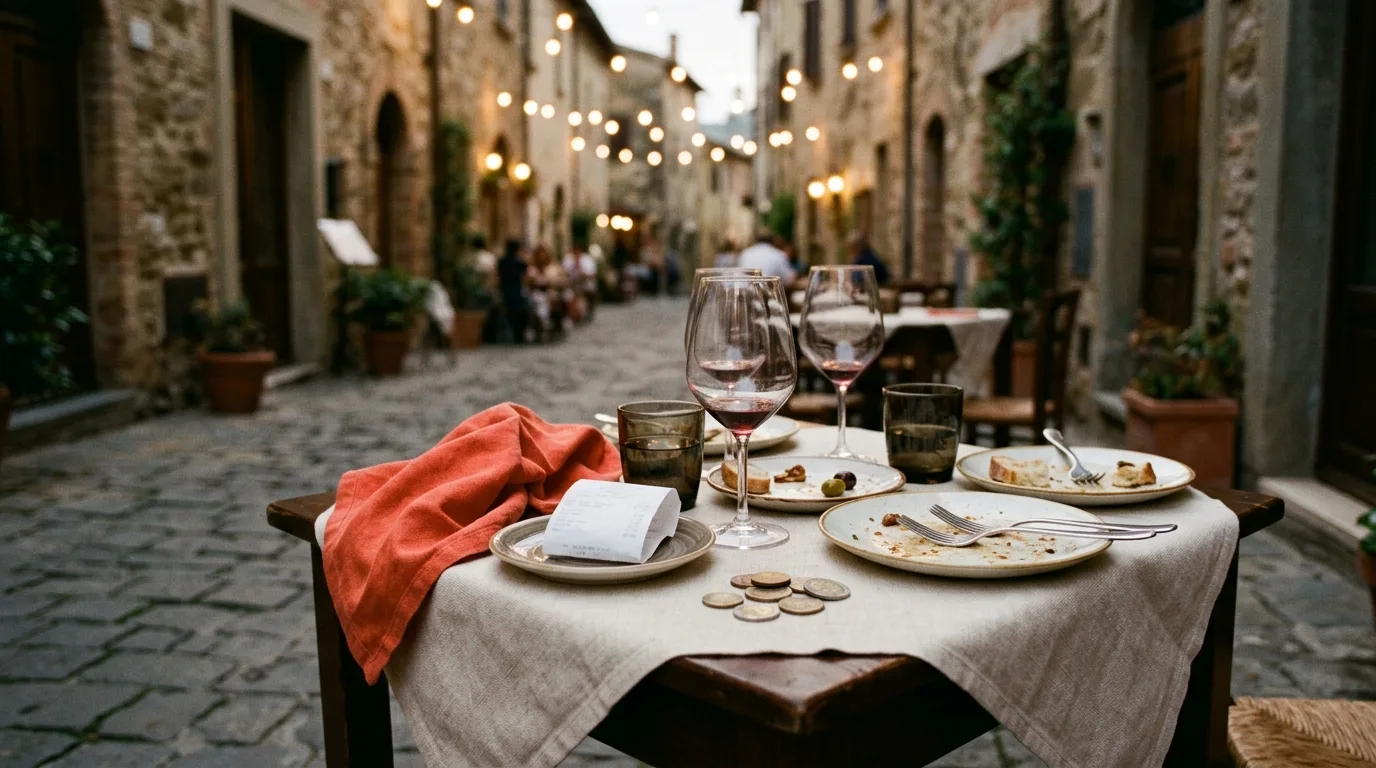






You checked the menu, ordered one main course, and skipped dessert to save money. So why does the bill look like it went on a little adventure of its own?
Eating abroad is one of the great pleasures of travelling. You discover new flavours, explore local food traditions, and occasionally order something because the menu description sounds delicious—even though you have absolutely no idea what it is.
Then comes the bill.
Suddenly, your relaxing dinner becomes a mathematics exam. There are extra charges, unfamiliar words, percentages, and a total that seems suspiciously larger than the prices you remember seeing.
Did you accidentally order a second dinner for someone hiding under the table?
Probably not. The explanation may be much simpler: restaurant customs vary enormously between countries, and the price of your meal is not always the whole story.
Here are five restaurant-bill surprises worth knowing before your next trip. Your future self—and your travel budget—will be grateful.
1. The Service Charge: Have You Already Paid the Tip?
You have enjoyed your meal, the waiter has been lovely, and now the bill arrives with a mysterious extra line: service charge.
Your first thought might be, “Oh, I should leave a tip as well.”
Your second thought might be, “Wait, how many times am I supposed to pay for the same service?”
Welcome to the international confusion surrounding tipping.
In the United States: the tip is a big deal
In the United States, tipping at a sit-down restaurant is generally expected. A tip of around 18–20% is a common planning guideline, although local practices, service quality, and restaurant policies can vary.
For example, if your food costs $50 before tax, a 20% tip would be another $10. Suddenly, your supposedly $50 dinner has become a $60 dinner before any applicable sales tax is added.
And if you are dining with friends, everyone may have a slightly different opinion about the correct percentage. One person reaches for the calculator, another says “just split it evenly,” and a third has disappeared to the bathroom at a remarkably convenient moment.
International friendship is beautiful.
Dividing restaurant bills is where it gets tested.
In the United Kingdom: check the bottom of the bill
British restaurants sometimes add a service charge, often around 12.5%. In many cases, this charge is discretionary, meaning you can ask for it to be removed.
If a service charge is already included, you generally do not need to add another tip unless you particularly want to.
Before adding anything, check the bill. Otherwise, you might tip twice without realizing it.
In France: service is generally included
France takes a different approach. Restaurant menu prices generally include service, so tipping is optional rather than an automatic percentage added on top.
You can leave a little extra if you have received particularly good service, but there is no need to panic if you do not perform a complicated mental calculation before leaving the table.
Travel tip: Look for phrases such as service compris or service charge. They can help explain what you are already paying for.
The golden rule is simple: check first, tip second, and never assume that your home country's habits apply everywhere.
2. The Bread Trap: When the Free-Looking Basket Isn't Free
A basket of bread appears on your table.
You did not order it. Nobody asked whether you wanted it. It simply arrived, looking warm, inviting, and entirely innocent.
Naturally, you eat a piece.
Then another.
Then you discover that the bread was not necessarily free.
This is particularly worth watching for in Italy, where restaurant bills may include a coperto, a cover charge associated with the table setting and dining service, or a charge for bread. Some establishments may also list a servizio, meaning a service charge.
These terms do not all mean the same thing, and practices vary by restaurant and location. A coperto is not automatically a tip for the waiter.
Imagine sitting down for a pasta dinner and finding a charge you had not expected. The amount might be small, but the surprise is enough to make you look at the bread basket with new suspicion.
“Were you a complimentary snack,” you wonder, “or a financial commitment?”
To avoid confusion, check the menu for words such as coperto, pane (bread), and servizio. If the information is unclear, ask before ordering.
There is no need to refuse every bread basket out of fear. Italian bread is perfectly capable of being delicious without becoming the villain of your holiday story.
Just establish the terms of the relationship first.
3. Water: The Most Expensive Thing You Didn't Mean to Order?
You sit down after a long day of sightseeing. Your feet hurt, the weather is warm, and you desperately need a drink.
The waiter asks what you would like to drink.
“Water, please,” you say, imagining a simple glass of the ordinary stuff.
But abroad, even water can come with choices.
In many restaurants, you may be offered bottled still water, sparkling water, or tap water. The bottled options usually cost extra, and the price may be higher than you expect in a touristy restaurant.
France: ask for a carafe
In France, you can generally ask for une carafe d'eau—a carafe of tap water—when dining in a restaurant. It is a useful phrase to remember if you do not want bottled water.
That little request can save you money and help you avoid receiving a bottle you never intended to order.
Italy: still or sparkling?
In Italy, restaurants commonly offer bottled water, either naturale (still) or frizzante (sparkling). These are normally paid options.
If you ask for water without specifying which kind, you may be asked to choose. It is not a trick, but it is worth knowing what you are agreeing to.
The United States: ask what is available
In the United States, tap water is often available on request at sit-down restaurants, but policies and practices vary. Bottled water is generally a separate purchase.
The lesson is not that water is secretly expensive everywhere. It is that “water, please” can mean different things depending on the restaurant.
Travel tip: If you want tap water, ask for it specifically. If you prefer bottled water, check the price when it matters to your budget.
Hydration should not require a financial strategy meeting.
4. The Menu Price Isn't Always the Final Price
You spot a delicious main course listed for $20.
Excellent. Add a drink, and your meal should still be manageable.
Then the bill arrives, and the total is higher than expected.
What happened?
In some countries, advertised menu prices may exclude certain taxes or charges that are added to the bill. In the United States, for example, sales tax is commonly added at checkout, and the rate varies by location.
So the $20 dish might not cost exactly $20 once tax is included. If you also need to budget for a tip, the difference becomes more noticeable.
This is why comparing restaurant prices across countries can be surprisingly difficult. A dish listed at one price in one place may have a different final cost from a similarly priced dish elsewhere.
In France, by contrast, restaurant prices displayed to consumers generally include applicable taxes and service. That makes the listed price a more straightforward guide to what you will pay, although optional extras can still affect the total.
The practical lesson? Do not compare menu prices without considering the local pricing system.
If you are travelling on a budget, leave some room for taxes, service charges, and drinks rather than spending your entire dining allowance on the first item that catches your eye.
And if the menu says “market price,” perhaps ask what that means before ordering. It is a phrase that can be perfectly reasonable—or a very effective way to make your wallet sweat.
5. Japan's No-Tipping Surprise: Don't Leave Extra Money Just Because You're Used to It
After dinner in the United States, you may automatically calculate a tip. In parts of Europe, you might round up the bill. But in Japan, the usual restaurant custom is different.
Tipping is generally not expected in Japanese restaurants. Good service is normally considered part of the experience, rather than something that requires an additional payment from the customer.
If you leave money on the table, staff may assume you have forgotten your change and try to return it.
Imagine walking away proudly after leaving what you consider a generous tip, only to have someone follow you down the street to give the money back.
You are not in trouble. You have simply encountered a different set of social expectations.
Instead of tipping, you can show appreciation with a polite arigatou gozaimasu—thank you very much.
Of course, Japan is not the only country where tipping is uncommon, and customs can vary in tourist-oriented establishments or for particular services. But for an ordinary restaurant meal, you generally do not need to add a tip.
The bigger lesson is that more money does not always mean more appreciation. Sometimes, respecting local customs is the best way to say thank you.
A Few More Things to Check Before You Pay
Before you put your card on the table, take a moment to scan the bill.
- Check the total against the menu. Make sure you recognize the dishes and drinks listed.
- Look for extra charges. Service, cover, bread, and other fees may appear under local names.
- Check whether tax is included. This is particularly useful in places where tax is added at checkout.
- Understand the tipping custom. Do not automatically apply the same percentage everywhere.
- Ask if something is unclear. A polite question is usually much easier than trying to decode a receipt while everyone waits.
And remember that restaurants within the same country can have different policies. A neighborhood café, a hotel restaurant, and a luxury dining room may not follow exactly the same practices.
These are general travel guidelines, not universal rules. Check current local advice when planning a trip, especially if you are visiting a destination with unfamiliar customs.
The Final Bill: A Small Travel Lesson
Eating abroad is about far more than finding the cheapest meal. It is a chance to experience how different cultures approach food, hospitality, and the simple act of sitting down together.
In one country, tipping is an expected part of restaurant dining. In another, service is already included. Somewhere else, the bread basket may come with a charge, while a glass of tap water is available if you know what to ask for.
None of these customs automatically makes a restaurant better or worse. They simply reflect different ways of organizing the dining experience.
So enjoy the local specialties, order the dessert if you really want it, and do not let a confusing receipt ruin a lovely evening.
Just remember three things: read the menu, check the bill, and ask questions before agreeing to extras.
Because the only surprise you really want at the end of dinner is discovering that the chocolate cake is even better than it looked.
Your wallet may not thank you for the cake.
But your holiday memories probably will.