
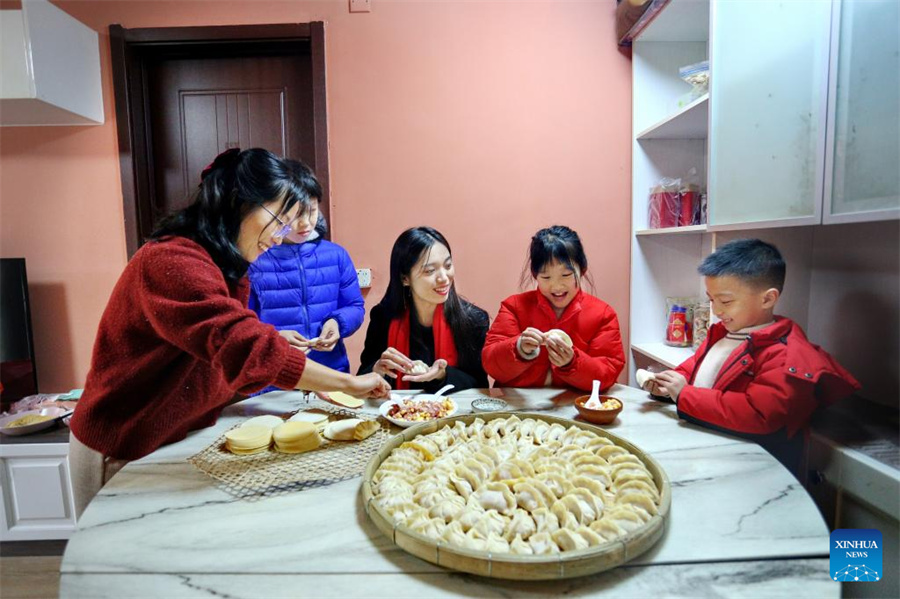






In China, making dumplings for Lunar New Year is a family tradition. It is also an excellent way to discover who has patience, who has talent, and who should never be allowed near a rolling pin unsupervised.
Imagine a family gathering around a kitchen table just before Chinese New Year. There is flour on the table, flour on the floor, flour on someone's sleeve, and possibly flour in a place nobody can explain.
A large bowl of filling sits in the middle. Someone is rolling little circles of dough, someone else is folding them into neat crescents, and an experienced grandmother is inspecting the results with the seriousness of a Michelin-starred judge.
Meanwhile, one uncle has been making the same dumpling for ten minutes.
It is still open.
Welcome to the wonderful world of jiaozi — Chinese dumplings that bring families together during Lunar New Year. In many northern Chinese households, making these little parcels is an important part of the celebration. They represent good wishes for the coming year, offer a delicious excuse for family gatherings, and provide several hours of entertainment for anyone who enjoys watching relatives argue about the correct amount of filling.
But why make so many dumplings for one celebration? And why does everyone seem to take the job so seriously?
The answer involves ancient traditions, a little symbolism, and the simple magic of cooking together.
1. Little Dumplings, Big Hopes for the New Year
At first glance, a Chinese dumpling doesn't look particularly impressive. It is a small piece of dough wrapped around a filling, usually containing ingredients such as minced pork, vegetables, beef or other combinations chosen by the family.
But appearance can be deceiving.
The traditional Chinese dumpling, known as jiaozi (饺子), often resembles an ancient Chinese gold or silver ingot. These ingots were used as forms of currency in earlier periods, so the dumpling's shape has become associated with wealth and prosperity.
In other words, eating dumplings at New Year is a delicious way of expressing the hope that the coming year will bring good fortune.
Forget complicated financial strategies for a moment. Imagine sitting down to dinner and being told that your plate contains several little symbols of prosperity.
Suddenly, eating six dumplings doesn't sound excessive. It sounds like a long-term investment.
Of course, dumplings cannot guarantee a promotion, a successful business or a surprise deposit in your bank account. But they can make the New Year feel hopeful, and sometimes a hopeful beginning is a lovely thing in itself.
The Spring Festival is also a time to welcome the new year, reunite with relatives and share good wishes. In 2024, UNESCO inscribed the Spring Festival's social practices on its Representative List of the Intangible Cultural Heritage of Humanity, recognizing the traditions and community connections surrounding the celebration.
Dumplings are one delicious part of that wider cultural picture.
And unlike a motivational speech, they come with dipping sauce.
2. Why Make Hundreds When You Could Simply Buy Them?
Modern life offers a very tempting solution to almost every kitchen problem: buy the finished product.
Supermarkets sell frozen dumplings. Restaurants prepare them fresh. Food delivery apps can bring dinner to your door while you remain comfortably seated in your pajamas.
So why would a family spend hours preparing hundreds of dumplings by hand?
Because the activity itself is part of the celebration.
In many families, preparing New Year dumplings is a group effort. One person mixes the filling, another rolls the dough, and others wrap the dumplings. Someone may be responsible for boiling water, while children help arrange the finished pieces on trays.
The work becomes easier when everyone contributes, but the real reward is not simply finishing the food.
It is spending time together.
While hands are busy, conversations flow. Relatives catch up on work, school, relationships and family news. Older generations pass on techniques to younger ones, sometimes patiently and sometimes with the unmistakable expression of someone wondering why the younger generation cannot fold a dumpling properly.
A grandparent might show a child how to pinch the edges together. A parent might explain why the filling must not be too wet. Someone else might share a story about how the family celebrated New Year decades ago.
These small moments help traditions travel from one generation to the next.
And because everyone has a job, nobody can claim that they are merely supervising.
At least, not convincingly.
There is also a practical reason to make a large batch: dumplings are easy to prepare in quantity, and extra dumplings can be stored for later meals, depending on how they are prepared and kept.
But let's be honest. If you are making a hundred dumplings with a dozen relatives, you are not doing it solely because the freezer has excellent storage capacity.
You are making memories, one slightly lopsided parcel at a time.
3. The Family Dumpling Assembly Line
Every dumpling-making gathering develops its own rhythm.
First comes the preparation. The dough is mixed and rested, the filling is seasoned, and the work surface is cleared. Then the assembly line begins.
One person rolls the wrappers into circles. Another adds the filling. A third folds and seals each dumpling. Finished pieces are arranged on trays, ready to be cooked or stored.
It sounds straightforward.
Then the first argument begins.
"That's too much filling."
"It's not enough filling."
"Your dumpling is leaking."
"Your dumpling looks like a tiny pillow."
At some point, someone will demonstrate a supposedly perfect folding technique, only for the next person to produce something that looks like a seashell after a minor disagreement with gravity.
Children may create imaginative shapes. Teenagers may attempt to finish the task as quickly as possible. Grandparents may quietly repair everyone's mistakes while insisting that the younger generation needs more practice.
And one relative will inevitably disappear just as the difficult work begins, returning when the first batch is ready to eat.
This person has mastered a very different culinary skill: strategic timing.
Yet there is something charming about the whole process. The dumplings do not have to be identical. Some are plump, some are delicate, and some appear to have been assembled during a minor earthquake.
Once cooked and served, they all have a chance to become part of the celebration.
The kitchen is not a factory. It is a place where family members work, talk, laugh and occasionally steal a little filling when they think nobody is watching.
Although someone is always watching.
Usually Grandma.
4. What's Inside? The Great Filling Debate
One of the best things about dumplings is their versatility.
There is no single filling that every Chinese family uses. Recipes vary by region, household preference and available ingredients.
Pork and Chinese cabbage are familiar combinations. Other versions may contain beef, lamb, shrimp, chives, mushrooms, eggs or different vegetables.
Some families follow recipes passed down through generations. Others experiment with new combinations or adapt their fillings to suit different diets.
This is where the kitchen conversation becomes particularly lively.
One person insists that the family recipe must remain unchanged. Another suggests adding a new ingredient. A third declares that the old recipe is already perfect and should not be disturbed by unnecessary innovation.
It is a familiar debate in kitchens around the world.
If you want to introduce a new filling to a traditional family gathering, you may need more courage than it takes to try the actual dumplings.
And then there is the question of seasoning. Too much salt? Not enough ginger? Should the vegetables be chopped more finely?
Every family has its preferences, and everyone seems to have an opinion.
The result is a meal that carries individual memories. A particular filling may remind someone of their childhood home, a grandparent's cooking or the New Year celebrations they attended as a child.
Food has a remarkable ability to preserve these memories. A recipe can travel across cities and countries, remaining familiar even when the people who first made it are far away.
That is one reason traditional dishes can feel so meaningful. They offer a taste of home that no restaurant menu can entirely reproduce.
Even if the restaurant folds its dumplings much more neatly.
5. The Lucky Dumpling: A Tiny Surprise with Big Expectations
Some families have a playful New Year custom involving a special dumpling.
Traditionally, certain households have hidden a coin or another small token inside one dumpling, with the person who finds it believed to be especially lucky in the coming year. Other families may use different customs, or skip the surprise entirely.
The idea is simple: everyone eats together, but one person gets an unexpected moment of celebration.
Imagine taking a bite and discovering that you have won the family's unofficial New Year lottery.
Suddenly, everyone is looking at you.
Perhaps you will enjoy good luck, prosperity or a particularly wonderful year. Perhaps your greatest achievement will be winning an argument about which television programme to watch.
Either way, you have a story to tell.
Today, anyone recreating this tradition should avoid putting an actual coin or other hard, inedible object inside food, since it can cause choking or damage teeth. A safer approach is to designate one dumpling with a distinctive, edible filling or mark it before serving.
The lucky surprise can remain without turning dinner into an unexpected dental appointment.
And if you happen to find the special dumpling, do try to look appropriately delighted. Someone has spent hours preparing the meal, and the family deserves a little drama.
6. Midnight, Dumplings and a Fresh Start
In some northern Chinese households, dumplings are eaten around the transition from New Year's Eve to New Year's Day. Practices vary, but the timing can add another layer of meaning to the meal.
The old year is coming to an end. Family members gather, food is shared, and everyone looks ahead to what the new year might bring.
The dumpling's name is also associated in popular explanations with wordplay about the transition between years, adding to its festive symbolism.
But the most powerful part of the tradition may be much simpler.
Everyone is sitting at the same table.
Some relatives may have travelled a long distance to return home. Others may have spent weeks preparing for the holiday. Children are excited, older family members are sharing stories, and the kitchen is finally quiet because the cooking is finished.
For a moment, the work is over.
The trays are emptying, the steam rises from the bowls, and someone is already asking whether there are more dumplings coming.
Of course there are.
You made a hundred.
And if there aren't enough, somebody will probably announce that next year the family needs to make two hundred.
This is how traditions grow.
Not necessarily through grand declarations, but through small decisions repeated over time: make the dough, prepare the filling, gather around the table, and save a place for everyone.
7. More Than a Meal
It is easy to look at a plate of Chinese dumplings and see only food. But during Lunar New Year, they can represent much more: prosperity, reunion, family memories and hopes for the future.
Their significance is especially strong in northern Chinese traditions, although New Year customs differ across China and among Chinese communities around the world. Not every family makes dumplings, and not every family celebrates in exactly the same way.
Still, the shared act of preparing food has a universal appeal.
Whether it is dumplings in China, tamales in Mexico or homemade pastries during a holiday elsewhere, cooking together can transform a recipe into a family ritual.
The ingredients matter, of course. So does the taste.
But the conversations around the kitchen table may be the part people remember longest.
Years later, someone might forget exactly how much ginger went into the filling. They may not remember how many dumplings were made or which batch had the neatest folds.
They will remember Grandma's instructions, the uncle who kept stealing the filling, the child who made a dumpling shaped like a tiny shoe, and the laughter that filled the kitchen.
And perhaps that is the real secret behind making hundreds of dumplings for one celebration.
The family isn't simply preparing enough food for everyone.
It is making room for everyone to be part of the tradition.