






Some dishes fill your stomach. Others give you a history lesson without making you open a textbook.
Cao lau does both.
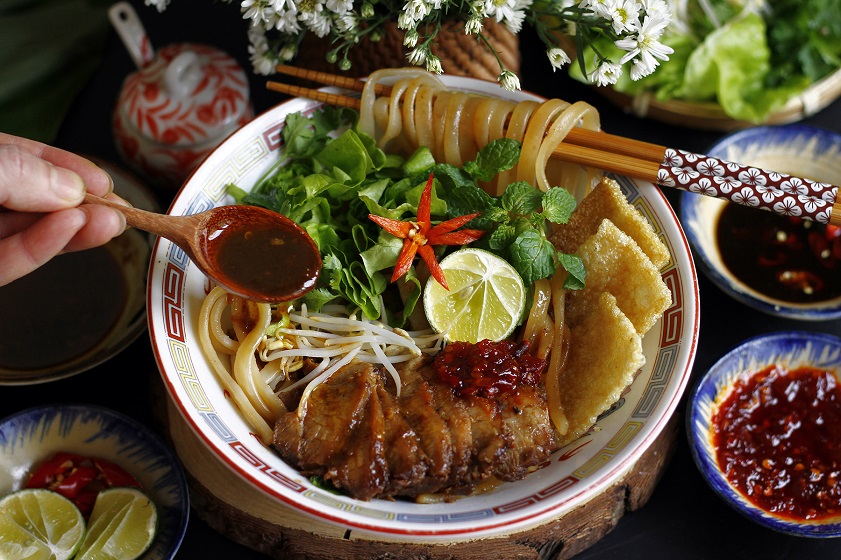
At first glance, it looks like a simple bowl of thick noodles topped with roasted pork, fresh herbs, and crispy crackers. No dramatic mountain of noodles, no swimming pool of broth, no elaborate decorations. Yet this humble dish carries traces of Hội An’s centuries-old trading history—and a few culinary mysteries that make it even more intriguing.
Think of it as a bowl of noodles with an international passport.
A Bowl Born in a Trading Port
 Long before Hội An became famous for its yellow houses, lantern-lit streets, and Instagram-worthy riverside views, it was a thriving international trading port. From around the 15th to the 19th century, merchants from China, Japan, and other parts of the world came here to trade goods and build communities.
Naturally, people brought more than silk, ceramics, and business deals. They brought their food traditions, too.
Cao lau is often associated with this cultural mixing. Its thick, chewy noodles remind people of Japanese noodles, while the five-spice roasted pork resembles Chinese char siu. Fresh herbs, local rice, and the Vietnamese way of balancing rich flavors give the dish its own unmistakable identity.
The exact origins of cao lau remain uncertain, so it would be a stretch to give one country all the credit. But that is part of the charm: the dish reflects a town where cultures met, traded, adapted, and created something new.
Apparently, international cooperation tastes better with pork.
The Noodles That Refuse to Be Ordinary
The real star of cao lau isn't the pork. It's the noodles.
Unlike the soft, flat noodles in phở, cao lau noodles are thick, firm, and satisfyingly chewy. Their slightly yellowish-brown color and distinctive texture make them easy to recognize.
Traditionally, the rice used for the noodles is treated with alkaline water made using wood ash. Local stories also connect the process with water from Hội An's ancient Bá Lễ Well and ash from nearby Cù Lao Chàm. These methods help give the noodles their characteristic texture.
But a small reality check: the precise ingredients and techniques used today can vary, and the famous well-and-ash story is not a universal rule followed identically by every producer.
Still, the tradition tells us something important. In Hội An, making noodles has long been about more than mixing rice flour with water. Local knowledge, materials, and technique all help shape the final bowl.
Try explaining that to someone who thinks all noodles are basically the same. You may need a second serving.
Pork, Herbs, Crunch—and Just Enough Sauce
A good bowl of cao lau is a little orchestra of textures.
First, there are slices of marinated roasted pork, usually seasoned with ingredients such as five-spice powder, garlic, and soy sauce. The meat brings a savory, slightly sweet richness.
Then come the fresh herbs and bean sprouts, adding brightness and crunch. Crispy pieces of fried dough or noodles provide another layer of texture, while a small amount of concentrated sauce coats the ingredients.
And yes, there is very little broth.
If you're expecting a steaming bowl of noodle soup, cao lau may leave you wondering whether the kitchen forgot to finish the job. It didn't. The dish is designed to be relatively dry, with just enough savory liquid to bring everything together.
Every bite gives you something different: chewy noodles, tender pork, fragrant herbs, and a crisp little crunch.
It is deliciously uncomplicated—and surprisingly difficult to recreate with the wrong noodles.
Why Eat Cao Lau in Hội An?
 You can find Vietnamese noodle dishes in restaurants around the world, but cao lau is especially tied to its hometown.
That connection makes it a perfect excuse to explore Hội An beyond its famous landmarks.
Visit the old town, admire the architecture, and wander through the streets where Chinese assembly halls, Japanese influences, and Vietnamese traditions coexist. Then find a local eatery and order a bowl of cao lau.
Suddenly, the town's history feels less like something displayed behind glass. It becomes something you can actually taste.
You don't need to identify every historical influence in your bowl. Just notice how the ingredients work together—and how a dish rooted in one place can tell a story about people who came from somewhere else.
For the full experience, try cao lau at lunchtime, when it makes a satisfying meal before another round of exploring. And if you find yourself comparing every noodle dish you eat afterward to Hội An's chewy, distinctive version, well, that's between you and your future lunches.
More Than a Local Specialty
Cao lau isn't famous because it uses the most expensive ingredients or follows the most complicated recipe. Its appeal comes from the way ordinary ingredients become extraordinary through local tradition.
Rice becomes distinctive noodles. Roasted pork meets fresh herbs. Techniques and flavors from different cultures find a home in one bowl.
And Hội An gets a dish that belongs to its story.
That may be the most interesting thing about food when you travel: a meal can reveal how people lived, traded, borrowed ideas, and made them their own. You arrive expecting lunch and leave with a better understanding of the place.
So, the next time you visit Hội An, don't just photograph the lanterns or stroll past the old merchant houses. Find a bowl of cao lau, pick up your chopsticks, and take a bite of the town's history.
Just don't call it ordinary noodles.
This bowl has traveled further than you have—even if its most important journey happened centuries ago.