
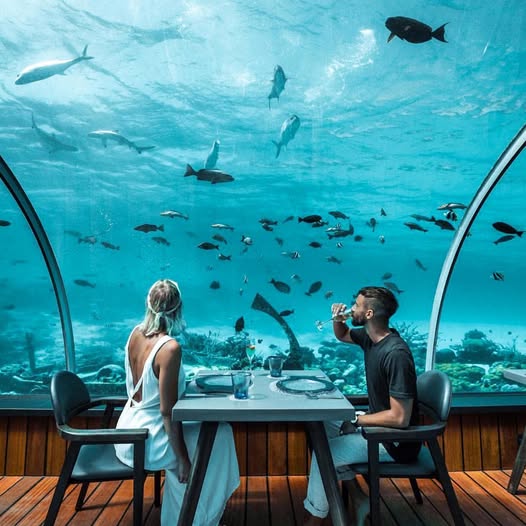





Imagine eating lobster while a shark glides past your window. Romantic? Absolutely. Slightly distracting when you're trying to enjoy your main course? Also possible.
There are restaurants with ocean views, restaurants beside the ocean, and then there are restaurants where the ocean is practically your dining-room wallpaper.
Welcome to the Maldives, where luxury hotels have taken the simple act of eating dinner and turned it into an underwater adventure. Here, you can sit several metres below the surface, surrounded by glass, while tropical fish drift past and sharks cruise by like they have important dinner reservations of their own.
It sounds magical. It also sounds expensive enough to make your bank account quietly leave the room.
So, what is it really like to dine beneath the Indian Ocean? And more importantly, is the experience worth the price?
1. A Restaurant Where the Ocean Is the Main Attraction
The Maldives is famous for its white-sand beaches, turquoise lagoons and villas perched above impossibly blue water. But some resorts offer something even more unusual: fully submerged restaurants where diners can admire marine life without putting on a swimsuit.
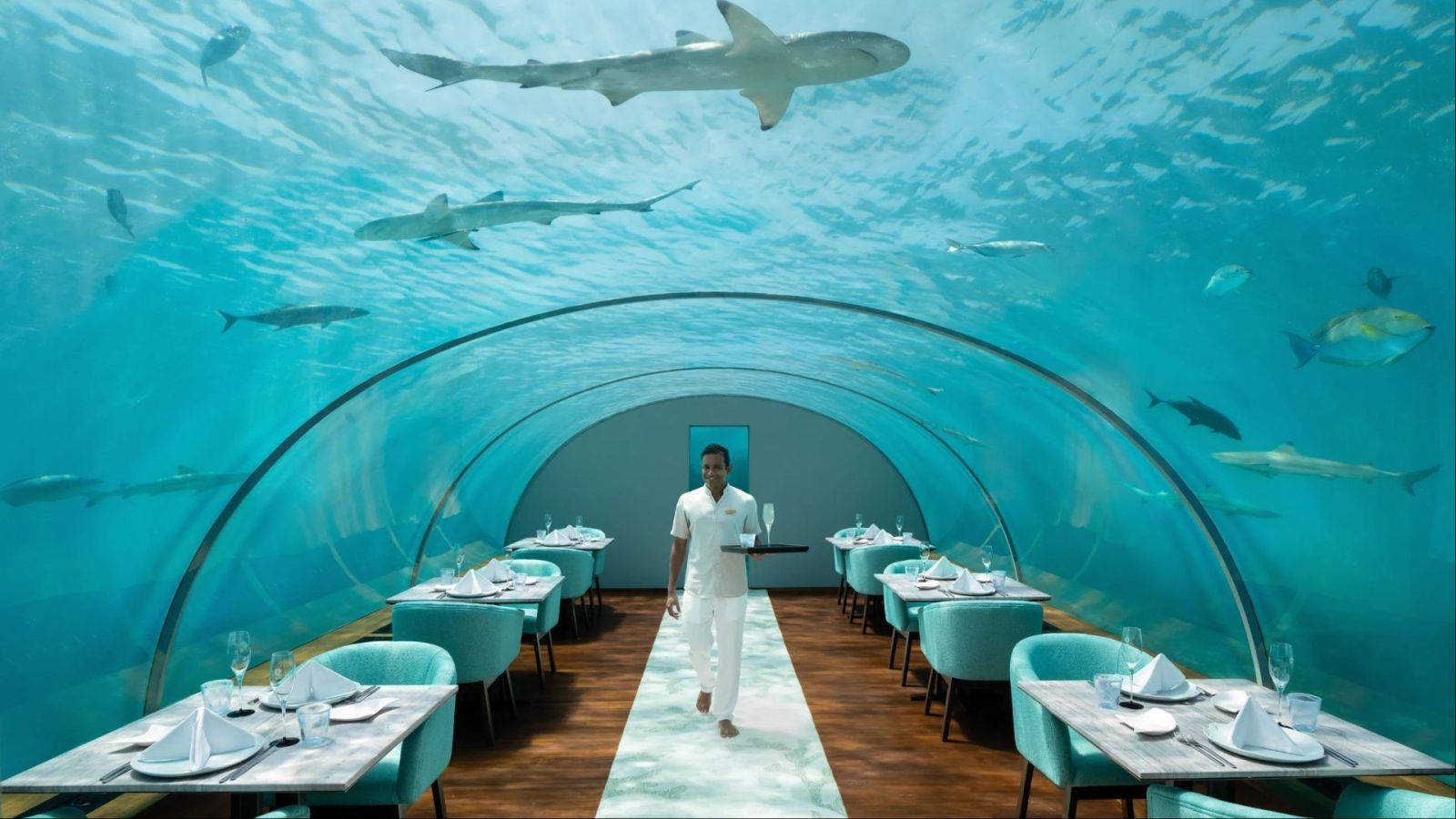
One of the best-known examples is SEA Underwater Restaurant at Anantara Kihavah Maldives Villas. Located around six metres below the ocean's surface, it offers panoramic views of the surrounding marine environment. Guests may spot tropical fish, turtles and sharks swimming beyond the glass as they enjoy a fine-dining meal.
The restaurant is designed to make the underwater setting part of the experience, rather than simply providing a table with a nice view. Anantara Kihavah also promotes its underwater wine cellar and carefully curated wine experiences, adding another layer of luxury to the occasion.
In other words, you aren't merely going out for dinner. You're descending into an aquarium where the fish are real, the lighting is provided by nature, and nobody needs to remind you not to tap the glass.
Although, to be fair, the fish probably aren't particularly interested in your dinner anyway.
The atmosphere is the real selling point. Sunlight filters through the water, marine life moves around the reef, and the restaurant's curved glass creates the sensation of being inside the ocean without actually having to become part of it.
For anyone who loves the sea, this can be a remarkable way to experience the Maldives from an entirely different perspective.
2. What Does Dinner Under the Sea Actually Taste Like?
 A spectacular view can make almost anything feel special. Even a sandwich eaten on a mountain tastes better than the same sandwich eaten while answering emails.
But underwater restaurants cannot rely on the scenery alone. At least, they shouldn't.
At SEA, the dining experience combines the underwater setting with sophisticated cuisine. Menu highlights have included fresh lobster ceviche, Hokkaido scallop tartare, Australian Wagyu beef and mango crème brûlée, with caviar featuring prominently in the restaurant's signature offering.
These are not exactly the ingredients of a quick Tuesday-night dinner.
The dishes are designed to be visually elegant as well as carefully prepared, with combinations of seafood, premium meats, delicate sauces and refined presentation. Wine pairings are also available for guests who want to turn the meal into a longer culinary experience.
Of course, the menu depends on the restaurant's current offering, so anyone planning a visit should check the latest details before booking.
And here's an important question: does food taste better when a turtle swims past?
Possibly not in a scientific sense. But the setting can change the way you experience a meal. You may find yourself slowing down, paying more attention to each course and enjoying the surroundings rather than rushing through dinner.
There is also the novelty factor. You might eat an excellent seafood dish in many parts of the world, but you cannot recreate the experience of watching marine life move around you simply by placing a fish tank next to your kitchen table.
Well, you could try. But your landlord might have questions.
3. The Price: Prepare for a Reality Check
 Let's talk about the part that might make you swallow your dessert before you've finished it: the cost.
Underwater restaurants in the Maldives are premium experiences, and prices vary considerably depending on the resort, menu, meal period and drinks.
For example, a published Anantara Kihavah dining guide listed five-course signature dinners at SEA from US$450 per person, with a seven-course option listed at US$560 per person, excluding beverages. The guide also stated that service charges and government taxes applied. These are reference prices from a published guide, not a guarantee of today's rates, so current prices should be confirmed directly with the resort.
And remember, that is the restaurant bill, not necessarily the cost of getting yourself to a remote Maldivian island in the first place.
Depending on your resort package, accommodation, transfers and other expenses may sit in entirely separate parts of the budget. Drinks and optional extras can add more to the final total.
Suddenly, the phrase just dinner becomes a rather ambitious description.
So what are you paying for?
First, there is the food itself: premium ingredients, skilled preparation and fine-dining service. Second, there is the restaurant's distinctive architecture and the work required to create a dining room beneath the sea. Third, there is the location. A remote island resort has different operating costs from a restaurant on an ordinary city street.
And then there is the experience that cannot easily be copied elsewhere.
You are paying for the privilege of sitting inside a carefully designed underwater space and watching the ocean become part of your meal.
Whether that feels worth the money depends on how much value you place on an unusual setting compared with the food alone.
If your main goal is to find the biggest plate of delicious food for the lowest price, this probably isn't the restaurant for you.
If you are celebrating a special occasion or looking for a memorable experience that goes beyond an ordinary dinner, the calculation becomes rather different.
4. The Instagram Photo Is Beautiful. But Is It the Whole Story?
Let's be honest: underwater restaurants are practically designed for social media.
Imagine a photograph of a beautifully presented dish, soft blue light filtering through the water, and a school of fish floating in the background. Add a caption about dining beneath the waves, and suddenly your ordinary dinner plans look like they need a career change.
But photographs can create expectations that real life doesn't always fulfil.
Marine life is wild, not a collection of paid performers waiting for the camera to arrive. You may see colourful fish swimming past throughout your meal, or you may spend a while admiring the same patch of reef. The visibility and lighting can vary with natural conditions, and there is no guarantee that a turtle will make a perfectly timed appearance when your main course arrives.
A shark might glide into view just as you lift your fork. It might also remain somewhere else entirely, enjoying a peaceful evening without any interest in your content strategy.
There is another consideration: the experience is not always as expansive as photographs suggest. The underwater dining room is a carefully designed space, and your view depends on your seat, the layout and the conditions outside.
That doesn't make the restaurant less impressive. It simply means the real experience is about more than getting one perfect photograph.
My advice? Enjoy the view first and take the photo second. The ocean has been putting on this show for considerably longer than Instagram has existed.
5. What You Should Consider Before Booking
If an underwater dinner is on your travel wish list, a little planning can make the experience more enjoyable.
Check the total cost, not just the menu price.
Ask whether the quoted amount includes taxes, service charges, drinks and any extras. If you're staying at the resort, check whether your meal is included in your dining plan or charged separately. A seemingly straightforward price can change once everything is added.
Look at the menu before you commit.
A beautiful location won't help if the menu doesn't suit your tastes or dietary requirements. Review the current menu and contact the restaurant in advance if you have allergies or need special arrangements.
Ask about the reservation policy.
Underwater dining rooms often have limited seating, and some experiences require advance reservations. Confirm the date, time, cancellation terms and whether the restaurant is open to non-resort guests. Access policies differ between properties.
Think about the occasion.
An underwater dinner may make sense for a honeymoon, anniversary, birthday or once-in-a-lifetime trip. If you're travelling on a tight budget, you might prefer to spend more of your money on activities you'll enjoy over several days rather than on a single meal.
There is no universal right answer. Travel is personal, and so is the way we decide what deserves our money.
Don't forget the rest of the Maldives.
The country offers much more than luxury dining: snorkelling, diving, local island communities, beaches and opportunities to learn about marine ecosystems. An underwater restaurant can be one highlight of a trip, but it doesn't need to become the entire holiday.
In fact, you may discover that a simple meal beside the beach, with the sound of the waves and your feet in the sand, becomes just as memorable.
And your wallet might send you a thank-you note.
6. Is Dinner Under the Sea Worth It?
The honest answer is that it depends on what you're hoping to get out of the experience.
If you judge a restaurant purely by portion size, price per bite or how many meals you could buy for the same amount of money, an underwater restaurant will be a difficult sell. You could eat very well elsewhere for considerably less.
But food experiences are not always about efficiency. Sometimes we travel to do something unusual, to celebrate a special moment or to see familiar things from a completely different perspective.
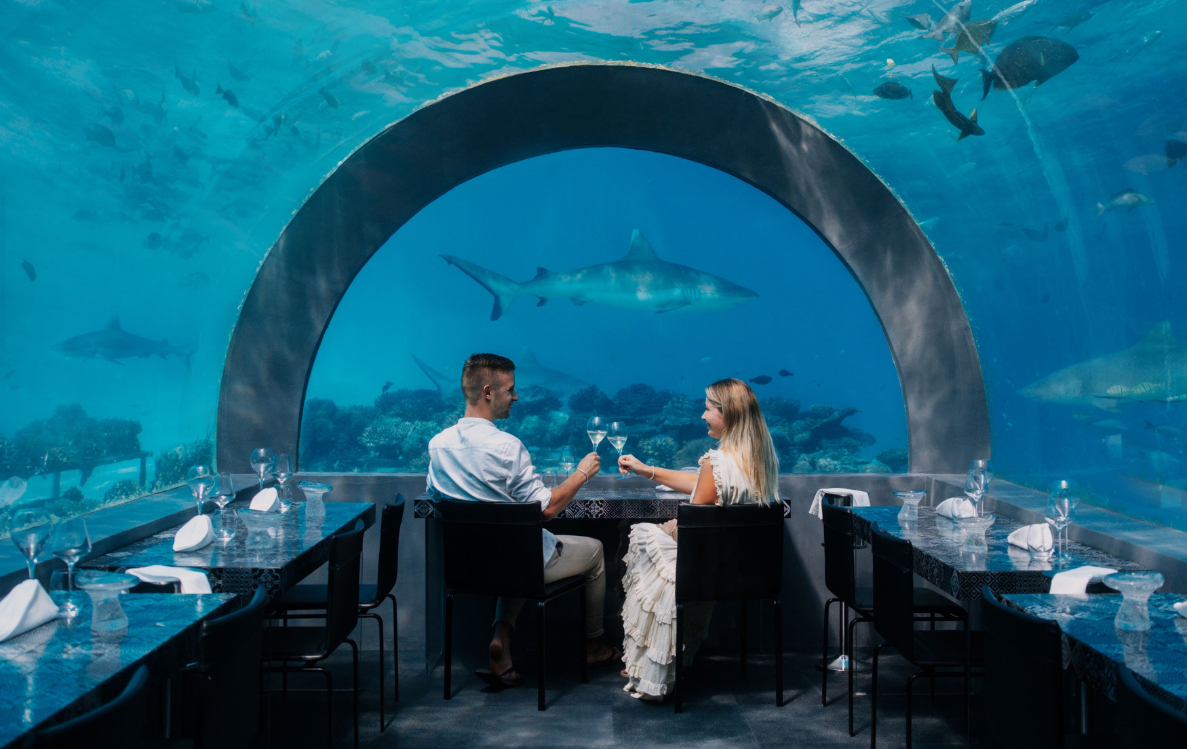
Dining beneath the Indian Ocean offers precisely that: a chance to experience the marine world from a protected, comfortable setting while enjoying a carefully prepared meal.
The setting is extraordinary, the food can be impressive, and the experience may stay in your memory long after the bill has disappeared from your inbox.
Still, the price is substantial, and the view is not guaranteed to deliver a cinematic wildlife encounter on demand. It is worth researching the menu, checking the full cost and deciding whether the experience fits your priorities.
For some travellers, it will be an unforgettable highlight. For others, a sunset dinner on the beach will deliver more happiness for a fraction of the price.
Neither choice is wrong.
Personally, I would put an underwater dinner in the category of something to consider for a genuinely special occasion, rather than an essential item on every Maldives itinerary.
Because the real luxury isn't simply eating somewhere expensive. It's choosing an experience you'll genuinely enjoy without spending the rest of your holiday wondering whether you should have ordered room service instead.
And if a shark happens to glide past while you're enjoying dessert, consider it a complimentary guest appearance.
Just don't expect it to split the bill.