
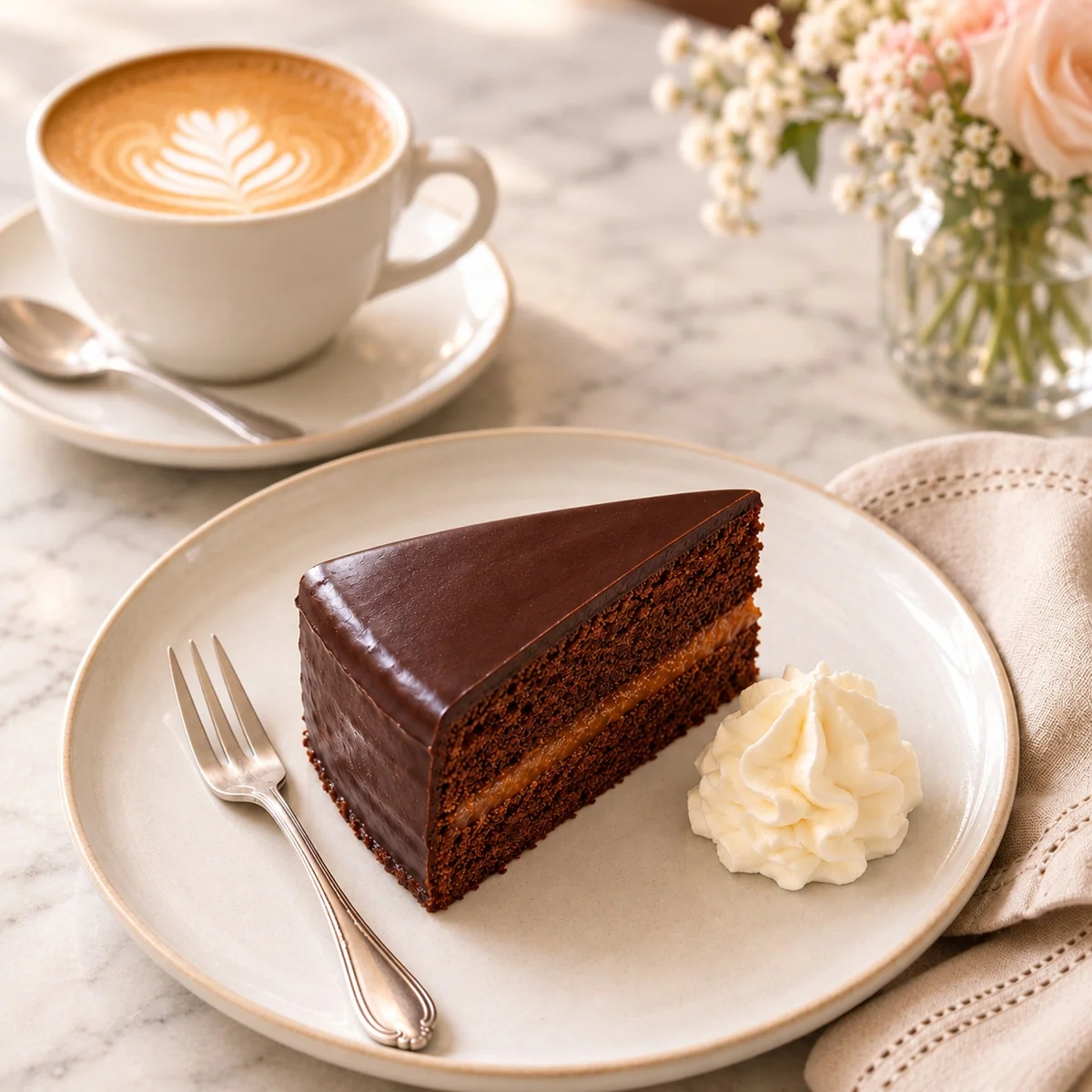






How a humble chocolate cake turned two of Vienna’s most famous establishments into rivals—and made dessert history.
Vienna has many things to be proud of: magnificent palaces, elegant architecture, classical music, and coffee houses where people can sit for hours discussing philosophy, politics, or absolutely nothing at all.
But ask a Viennese person about Sachertorte, and you may discover that chocolate cake deserves a place among the city’s greatest cultural treasures.
Not just any chocolate cake, either. We are talking about a dessert that inspired a legal battle lasting years, divided the loyalties of pastry lovers, and raised a question serious enough to reach the courtroom:
Who has the right to call their chocolate cake the original?
You might expect a dispute over land, money, or a royal inheritance. Vienna, however, managed to turn a slice of cake into a matter of national importance. And honestly, if you are going to argue about something, chocolate is not the worst place to start.
The teenager who accidentally made history
Our story begins in 1832, when a young apprentice chef named Franz Sacher was just 16 years old.
According to the Sacher family’s account, Prince Klemens von Metternich, a powerful Austrian statesman, wanted an impressive dessert for his distinguished guests. Unfortunately, the head chef was ill, leaving young Franz with a rather intimidating assignment.
Imagine being 16 and suddenly responsible for the dessert at an important dinner party. Most teenagers are struggling to make toast without burning it. Franz had to impress the sort of guests who probably owned more formal clothing than ordinary people owned furniture.
He rose to the challenge and created the early version of what would become the famous Sachertorte.
The basic idea was wonderfully simple: a rich chocolate cake, apricot jam, and a smooth dark chocolate coating. It was elegant without requiring a tower of decorations, edible gold, or a pastry chef with the patience of a saint.
The cake reportedly impressed the guests, and Franz’s creation began its journey into culinary history.
Of course, we should remember that this origin story comes largely from the Sacher establishment’s own historical account. The exact development of the recipe over the following decades is more complicated than one teenage chef having a brilliant afternoon.
Still, one thing is clear: Franz Sacher’s name became permanently attached to one of Austria’s most recognizable desserts.
Some people leave their mark on history by discovering something extraordinary. Franz did it with chocolate, apricot jam, and very good timing.
What exactly is a Sachertorte?
Before we get to the rivalry, let us appreciate the cake that caused all the trouble.
A traditional Sachertorte is a chocolate cake with a relatively firm, dense crumb, a layer of apricot jam, and a glossy dark chocolate coating. It is usually served with a generous spoonful of unsweetened whipped cream.
That last detail matters.
The cake is rich and chocolatey, while the apricot jam contributes a fruity tang that cuts through the sweetness. The whipped cream adds a soft, airy contrast to the dense cake.
Together, they make a dessert that is less about overwhelming sweetness and more about balance.
It is also not quite the soft, gooey chocolate cake many people imagine when they hear the words “chocolate dessert.” A Sachertorte is traditionally more structured and compact. It holds its shape beautifully, which is convenient when your cake is expected to survive both a journey across town and an argument about its authenticity.
And then there is the chocolate glaze. Smooth, dark, and polished, it gives the cake its distinctive appearance.
A slice of Sachertorte does not usually arrive looking like a dessert that has just returned from a food fight. It looks dignified.
Very Viennese, really.
But beneath that elegant exterior lay the beginnings of a rather complicated family story.
Enter Demel: another pastry shop, another claim to fame
Franz Sacher’s son, Eduard Sacher, followed his father into the culinary world.
During his training, Eduard worked at Demel, a celebrated Viennese confectionery with roots dating back to the eighteenth century. There, the Sacher cake became part of the establishment’s pastry tradition.
Eduard later went on to establish the Hotel Sacher in Vienna in 1876, helping turn the family name into a major presence in the city’s hospitality scene.
This created an unusual situation.
On one side stood Hotel Sacher, associated with the cake’s creator and his family. On the other stood Demel, a historic confectionery that also had a connection to the dessert through Eduard’s work and subsequent arrangements involving the recipe.
Both establishments had reasons to take the cake seriously.
And neither was exactly operating a small neighborhood stall selling three biscuits and a cup of tea. These were prestigious Viennese institutions with reputations to protect.
For years, both sold their own versions of Sachertorte.
Then the twentieth century arrived, bringing new business arrangements, changing ownership, and a question that would make pastry history: who could legally claim the title “Original Sacher-Torte”?
A less ambitious person might have suggested putting both cakes on a plate and getting on with lunch.
Vienna, naturally, had other plans.
The Great Cake War
The dispute became particularly serious in the 1950s, when Hotel Sacher and Demel entered a lengthy legal battle over the name and the right to market their cakes as the genuine original.
The case was not simply a disagreement over who had baked the earliest chocolate cake. It involved commercial rights, historical connections, and the use of the name itself.
In other words, the court had to consider whether one establishment could claim a special title for a dessert that both businesses had been making and selling.
There was also a deliciously specific detail at stake: the apricot jam.
The two versions differed in how the jam was used. Hotel Sacher’s version included a layer inside the cake as well as apricot jam beneath the chocolate coating. Demel’s version became associated with jam beneath the glaze rather than a separate middle filling.
This may sound like an extremely small distinction to anyone who has never had a serious relationship with dessert.
But imagine spending years building a business around a signature product. Then imagine your competitor selling a very similar product under a name that customers associate with your business. Suddenly, a thin layer of jam becomes much more than a thin layer of jam.
It becomes a matter of identity.
The legal proceedings continued for years, attracting attention beyond the pastry world. The dispute became known as Vienna’s “cake war”—a wonderfully Austrian-sounding conflict in which the weapons were lawyers, the battlefield was the courtroom, and the prize was the right to use a particular name.
No actual cake-throwing is required for a conflict to be memorable. Although, given the subject, it would have been thematically appropriate.
So, who won?
After years of legal wrangling, the two sides reached a settlement in 1963.
Hotel Sacher secured the exclusive right to use the name “Original Sacher-Torte” for its cake. Demel, meanwhile, continued selling its own version, now commonly known as “Demel’s Sachertorte.”
The distinction remains important today.
Hotel Sacher’s version is known for its two layers of chocolate cake with apricot jam in the middle and beneath the chocolate glaze. Demel’s version is traditionally associated with apricot jam beneath the glaze, without that extra layer in the centre.
Both are recognizable interpretations of the same famous Viennese dessert, but only Hotel Sacher can use the protected “Original Sacher-Torte” designation for its version.
That does not mean Demel’s cake suddenly became a culinary failure. Far from it. Demel remains a historic confectionery in its own right, with a long tradition of Viennese pastry-making.
The settlement simply gave the two establishments different names under which to continue their chocolate business.
After all those years, the city finally had a legal answer.
Whether it had a universally accepted answer among cake lovers is another question entirely.
Vienna’s coffee houses: where cake becomes a cultural event
To understand why Sachertorte matters so much, you need to understand Vienna’s coffee-house culture.
A traditional Viennese coffee house is more than a place to buy caffeine. It is somewhere to sit, read a newspaper, talk with friends, observe strangers, or spend an unreasonable amount of time deciding what to order.
Historically, these establishments have played an important role in the city's social and cultural life. Writers, artists, journalists, and intellectuals have gathered in coffee houses, sometimes staying long enough that a single coffee seems to qualify as a long-term rental agreement.
And what goes naturally with coffee?
Cake, of course.
Sachertorte fits beautifully into this world. A slice of dense chocolate cake, a little apricot sharpness, a spoonful of whipped cream, and a cup of strong coffee make an excellent afternoon combination.
There is no need to rush. In fact, rushing would rather miss the point.
Vienna invites you to sit down, take a bite, and allow the rest of the world to manage without you for a while.
Your emails can wait. Your laundry can wait. That mysterious message from someone who writes “Can we talk?” without explaining why can definitely wait.
You have cake.
Where should you try the famous cake?
If you visit Vienna, two obvious stops for Sachertorte are Hotel Sacher and Demel.
At Hotel Sacher, you can try the version that carries the official “Original Sacher-Torte” name. The experience combines the cake with the atmosphere and history of the establishment most closely associated with the legal victory.
Demel offers another perspective on the same dessert tradition. Its historic confectionery is worth visiting for its pastry heritage and old-world Viennese atmosphere, as well as its own interpretation of Sachertorte.
Which should you choose?
That depends on what interests you most. Perhaps you want to taste the officially designated original. Perhaps you are curious about the rival version. Or perhaps you simply want an excuse to visit two famous pastry establishments and call it cultural research.
The third option is particularly convincing.
If you have time, try both on separate visits. Pay attention to the texture of the cake, the chocolate coating, the apricot jam, and how each version tastes with whipped cream and coffee.
You do not need to announce a winner. You are on holiday, not presiding over the Supreme Court of Chocolate.
And if you prefer one version, that is perfectly fine. Taste is personal, even when history insists on making it complicated.
More than a slice of chocolate cake
Today, Sachertorte is one of Austria’s best-known culinary symbols. It appears in cafés, pastry shops, cookbooks, and souvenir boxes, carrying a little piece of Vienna to chocolate lovers around the world.
Its story is also a reminder that food traditions rarely belong to just one moment or one person. Recipes evolve as they pass between chefs, families, businesses, and generations. A dessert can begin in one kitchen and acquire an entirely new identity as others adapt, refine, and popularize it.
The Sachertorte dispute was about more than apricot jam or chocolate glaze. It was about heritage, reputation, ownership, and the commercial value of being known as the original.
But the most charming part of the story is that the rivalry did not make the cake disappear. Both establishments continued making their versions, and visitors still have the opportunity to experience both traditions.