
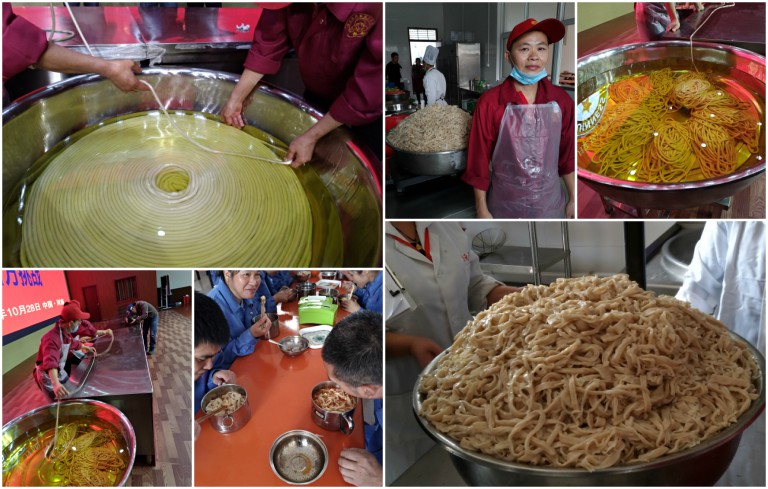






Most people are happy if their noodles are long enough to reach the bottom of the bowl. But in China, some noodle makers have taken the idea of “long noodles” to a completely different level.
We are talking about noodles stretching for metres, noodles made with techniques passed down through generations, and even one legendary noodle measuring more than three kilometres.
Yes, three kilometres. That's not lunch anymore. That's a small road project.
But behind these impressive lengths lies something much more interesting than a food record. Noodles are deeply woven into Chinese food culture. They represent longevity, good wishes, family celebrations, regional identity, and the remarkable skill of people who know exactly how to persuade a lump of dough to become something extraordinary.
So, how does someone make a noodle longer than a football field? Why do some Chinese families eat long noodles on birthdays? And what exactly stops all that dough from snapping halfway through?
Let's follow the noodle trail.
The Noodle That Was Nearly 3.1 Kilometres Long
In October 2017, a Chinese food company called Xiangnian Food Co. made a noodle that was officially recognised by Guinness World Records as the world's longest noodle.
Its length?
3,084.32 metres.
That's over three kilometres of one continuous noodle. If you laid it out along a road, you would need a very patient person to walk from one end to the other — and probably a very large plate.
The record-breaking noodle was made in Nanyang, Henan Province, using 40 kilograms of bread flour, 26.8 litres of water, and 600 grams of salt.
The production team spent 17 hours rolling and stretching the dough. Measuring the finished noodle took another three hours.
Imagine spending an entire working day making one noodle. Most of us struggle to make a cup of coffee without checking our phones.
And here's an important detail: it had to be one continuous piece. The team couldn't simply make several shorter noodles and join them together. That would be cheating, and Guinness was not about to let anyone get away with a giant dough-based shortcut.
Once the record was confirmed, the enormous noodle was cooked with garlic, egg, and tomato sauce. Around 400 employees and invited guests shared it at a banquet celebrating China's Double Ninth Festival.
The choice of occasion was no coincidence. In Chinese tradition, long noodles symbolise long life. The giant noodle was intended as a special wish for health and longevity, particularly for elderly guests.
So this was not simply a company trying to make the world's longest lunch. It was also a giant edible blessing.
How Do You Make a Noodle That Long?
Making ordinary noodles is already a small exercise in patience. Making noodles several metres long requires a much better understanding of dough.
One famous Chinese technique is called la mian, meaning hand-pulled noodles.
Instead of rolling the dough into a flat sheet and cutting it into strips, the noodle maker repeatedly stretches and folds a single piece of dough. Each folding and pulling cycle creates more strands, gradually transforming one thick piece into many thinner noodles.
The process looks almost like a magic trick, except the magician needs strong arms, excellent timing, and a very good understanding of flour.
The secret lies in gluten.
When flour and water are mixed and kneaded, proteins in the flour form a network called gluten. This network gives dough its elasticity and structure. It is what allows the dough to stretch instead of immediately falling apart.
But gluten needs the right treatment.
If the dough is too stiff, it resists stretching. If it is too weak, the strands break. If it has not rested enough, the gluten may remain too tight, making the dough difficult to work with.
Experienced noodle makers know when to knead, when to rest, and when to pull. Some traditional recipes also use an alkaline ingredient to help create the desired elasticity and texture.
The real skill is controlling the dough throughout the process.
A skilled la mian chef can repeatedly stretch and fold the dough until it becomes dozens or even hundreds of strands. The noodles can be made in different thicknesses, depending on the dish.
Watching an experienced chef work is surprisingly entertaining. The dough swings, stretches, folds, and flies through the air with impressive speed.
It almost looks like a noodle is being given a personal fitness programme.
And unlike many gym members, it actually gets thinner after all that exercise.
Not All Long Noodles Are Made the Same Way
The fascinating thing about long noodles is that different regions have developed their own techniques.
Some are pulled by hand, some are stretched into extremely thin strands, and others are dried into long bundles.
Here are two particularly interesting examples.
Fujian Misua: A Noodle Longer Than Your Living Room
In Fujian Province, southeastern China, there is a traditional thin wheat noodle known as misua.
Unlike the dramatic hand-pulled noodles often seen in restaurants, making Fujian misua is a much longer and more demanding process.
A traditional maker may stretch the dough to more than 30 metres before drying it.
One experienced craftsman, Huang Jia, was reported by the South China Morning Post in 2021 to have spent around 40 years making misua. He worked with more than 45 kilograms of dough a day, turning it into delicate strands through a combination of kneading, resting, stretching, and drying.
The process requires considerable physical effort. The dough is first prepared and rested to develop elasticity. It is then shaped into long strands and stretched repeatedly using traditional techniques and equipment.
Eventually, the noodles are taken outside to dry.
The finished misua is very thin and delicate, usually cooked in soup and served with ingredients such as scallions, shallot oil, and oysters.
It is also associated with birthdays and longevity celebrations.
A bowl of misua may look simple, but behind it are decades of experience and a technique that has been passed through generations.
And if you ever complain that making dinner takes too long, remember that someone somewhere has spent a lifetime perfecting a noodle that could stretch across several rooms.
The 500-Metre Potato Noodle
Wheat flour isn't the only ingredient capable of producing extraordinary noodles.
In November 2024, Guinness World Records reported a record-breaking potato noodle measuring 500.152 metres, made in Weichang County, Hebei Province, China.
That's longer than four American football fields placed end to end.
The noodle was created by a team of 14 skilled artisans. Instead of relying on the familiar hand-pulled wheat-dough method, the team used a traditional potato-noodle technique involving a large batch of dough, a specially shaped funnel, boiling water, and a cooling process.
The preparation required teamwork. Some participants worked on the dough, while others guided the emerging noodle through the cooking and cooling stages.
The finished noodle was then carefully measured and rolled onto a wooden wheel.
It was an impressive combination of traditional food craftsmanship and record-breaking ambition.
And it proves that noodles don't need wheat to have extremely big dreams.
Why Are Long Noodles So Important in Chinese Culture?
Now we come to the part that makes long noodles more meaningful than an impressive Guinness certificate.
In Chinese culture, noodles are often associated with longevity.
Long noodles, sometimes called longevity noodles or chang shou mian, are traditionally eaten on birthdays and other important occasions as a symbol of a long and healthy life.
The idea is beautifully simple: a long noodle represents a long life.
It is a way of expressing a wish for someone to enjoy many more years of happiness, health, and good fortune.
This is why longevity noodles are often served to older family members during birthday celebrations. They may also appear at other festive occasions, depending on regional and family traditions.
There is even a familiar custom of trying not to cut the noodles before eating them. Keeping the strand intact reinforces the symbolism of a continuous, long life.
Of course, this does not mean that one noodle guarantees another 100 years. If it did, Chinese birthday parties would be considerably more crowded.
The important thing is the meaning behind the gesture.
Food often carries messages that are difficult to express in ordinary conversation. A bowl of noodles can become a way for parents to wish their children success, for relatives to celebrate an elderly family member, or for friends to share good wishes at the beginning of a new year.
In this sense, longevity noodles are not just a recipe. They are edible good wishes.
The Noodle Rules: Why You Shouldn't Chop It Up
If you are served longevity noodles at a traditional celebration, you may notice that people make an effort to keep the strands long.
Why?
Because the length is part of the symbolism.
Cutting the noodle can be seen as interrupting the wish for a long life. Some people therefore try to eat the strand without breaking it into shorter pieces.
This is a cultural custom rather than a universal rule followed by every Chinese household. Dining habits vary between regions and families.
Still, it is easy to understand the idea.
Imagine someone wishing you a long, happy life and then handing you a pair of scissors. That would send rather mixed messages.
Long noodles also appear in different forms across Chinese cuisine. Some are served in clear soups, others are stir-fried, and some are accompanied by rich sauces, vegetables, meat, or seafood.
The ingredients and preparation methods vary, but the symbolism remains familiar: a long strand can express a wish for a long future.
From a Bowl of Noodles to a Culinary Art Form
It is easy to think of noodles as everyday comfort food. They are affordable, filling, versatile, and found in countless kitchens around the world.
But the world of noodles is much more sophisticated than it first appears.
A noodle maker must understand flour, water, texture, temperature, resting time, and the behaviour of dough. A slight change in the ingredients or preparation can affect whether the strands stretch smoothly or break apart.
In traditional noodle-making communities, these skills are often developed through years of practice and passed from one generation to the next.
The result is more than a meal. It is a form of craftsmanship that reflects local history and identity.
And that is why noodle-making traditions deserve attention beyond the occasional record-breaking headline.
The 3,084-metre noodle may have attracted international attention, but the everyday work of craftsmen making Fujian misua or chefs pulling fresh la mian is just as fascinating.
One is a spectacular achievement. The other is a living tradition.
Both remind us that even the simplest foods can involve extraordinary skill.
So, How Long Is Too Long for a Noodle?
After exploring three-kilometre noodles, 30-metre misua, and centuries of food traditions, we can probably agree that the definition of a “long noodle” needs an update.
For most of us, a noodle that refuses to fit neatly onto a fork is already inconvenient enough.
But in China, long noodles carry a much bigger meaning. They represent longevity, family connections, celebration, and the skill of generations of food makers.
The next time you sit down to a bowl of noodles, spare a thought for the person who made them. Behind those simple strands may be years of practice, a clever understanding of gluten, and a tradition that stretches much further than the noodle itself.
And if your noodles happen to be three kilometres long?
Well, you might want to invite a few friends.
Actually, invite 400. History suggests that is a reasonable starting point.