





Imagine walking into a restaurant expecting a delicious dinner and perhaps a little wine. You picture a beautifully set table, elegant plates, a friendly waiter, and someone explaining that the sauce has been reduced for approximately seventeen hours.
Now imagine being transported into a futuristic dome, surrounded by immersive visuals, served tiny edible creations that look like something from a laboratory, and encouraged to think about the future of humanity between bites.
Welcome to Alchemist, Copenhagen’s extraordinary restaurant where dinner can feel less like eating out and more like starring in a science-fiction movie with a very expensive catering budget.
Created by Danish chef Rasmus Munk, Alchemist combines fine dining with theatre, art, science, technology, and social commentary. Instead of simply serving one course after another, it takes guests through a carefully choreographed experience featuring up to 50 “impressions”—some edible, others designed to engage the senses without being conventional dishes.
The experience lasts around four to six hours, according to the restaurant. That is a long time to eat dinner. By the end, you might have reconsidered your relationship with food, learned something about the world, and forgotten whether you came for the dessert or the existential crisis.
So what actually happens inside this unusual restaurant? And is it possible for a meal to be both delicious and intellectually overwhelming?
1. Welcome to the Restaurant That Looks Like a Secret Laboratory
Alchemist is located on Refshaleøen, a former industrial area of Copenhagen known for its maritime and shipyard history. It is not the sort of place where you casually wander past a bakery, smell fresh cinnamon rolls, and decide to pop in for lunch.
The restaurant has a deliberately theatrical entrance, including monumental bronze doors. From the beginning, the experience feels designed to separate everyday life from whatever is about to happen inside.
This is not an accident. Alchemist’s philosophy, which it calls Holistic Cuisine, treats dining as something that extends beyond the food on the plate. Architecture, sound, lighting, visual effects, performance, and storytelling all contribute to the experience.
In other words, the restaurant does not merely ask, “Would you like fries with that?”
It asks, “Would you like to reconsider the human condition while enjoying an exquisitely prepared bite?”
A slightly more ambitious question, admittedly.
The concept was developed by Rasmus Munk, whose approach challenges the traditional idea that a restaurant meal should consist primarily of food, conversation, and perhaps an awkward debate about who ordered sparkling water.
At Alchemist, almost everything can become part of the show.
2. Fifty Impressions, Several Acts, and Absolutely No Ordinary Tuesday
A conventional tasting menu usually follows a familiar rhythm: starter, fish, meat, dessert, and the slow realization that you probably should not have eaten so much bread.
Alchemist takes a different approach.
Its experience can include up to 50 impressions, divided into different acts and presented across several spaces. Some are edible creations; others are visual, sensory, or theatrical experiences that help tell the story of the evening.
The word “impression” is important. It suggests that each element is meant to leave an impact rather than simply fill a place on the menu.
One moment, you might be concentrating on a beautifully constructed bite. The next, the room around you may become part of a larger visual presentation.
The unusual format is part of the attraction. Rather than letting guests settle into a predictable sequence of dishes, Alchemist continually changes the context in which the food is experienced.
The restaurant's official description emphasizes curiosity and an open mind. It even warns that the experience may not be suitable for a business discussion or a first date when both people are already nervous.
That seems fair. It is hard to make effortless small talk when the room is showing you something unexpected and your next course looks as if it has arrived from another dimension.
3. The Dome: Dinner Under a Different Universe
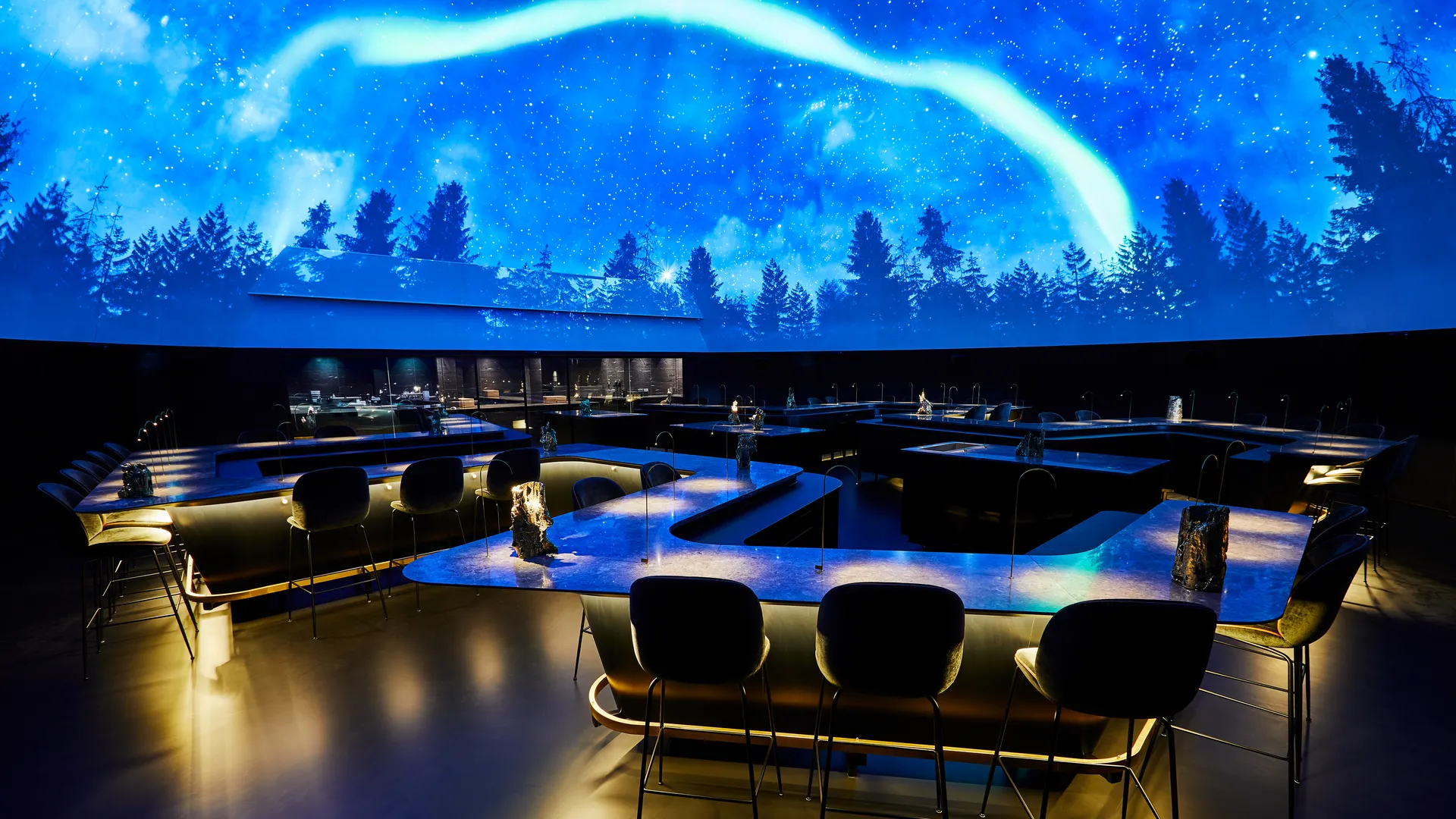
One of Alchemist's most distinctive spaces is its spectacular dome, where immersive projections transform the ceiling and surrounding environment.
Instead of looking at a blank wall while waiting for the next course, guests can find themselves surrounded by moving imagery that changes the atmosphere of the room.
The effect is closer to an immersive art installation or planetarium than a conventional dining room.
And that changes how you think about the food.
A small dish presented against a dramatic visual backdrop can feel very different from the same dish served on a white plate in a quiet restaurant. The environment influences attention, emotion, and expectation.
Alchemist uses that relationship deliberately.
The dome can create a sense of wonder, discomfort, beauty, or surprise. Its visual storytelling is not merely decorative wallpaper for people who have become bored with expensive furniture. It is part of the restaurant's wider artistic concept.
Of course, there is one practical question.
What happens if you need to concentrate on a tiny, carefully prepared bite while the ceiling is doing something spectacular?
You could miss the food.
You could miss the show.
Or you could spend the entire evening trying to look sophisticated while your eyes dart around the room like a curious cat watching six birds at once.
Multitasking has never looked so luxurious.
4. Food That Makes You Look Twice Before Taking a Bite

Alchemist is famous for creations that challenge expectations about what food should look like.
Some dishes resemble familiar objects, body parts, or materials that you would not normally associate with dinner. Others use surprising textures, elaborate presentation, or unexpected combinations to make diners question what they are seeing.
For example, Michelin Guide has highlighted a creation shaped like an oversized human eye, with a jelly-like surface and seafood ingredients inside. The dish is intended to comment on surveillance.
That is a lot of meaning to fit into one bite.
At an ordinary restaurant, an eye might suggest that the chef needs a new pair of glasses. At Alchemist, it can become a way to explore privacy, observation, and the modern world.
Other creations have addressed issues such as child labour and environmental pollution. Their presentation is designed to provoke thought rather than simply produce a photograph for social media.
The result can be playful, disturbing, beautiful, or all three.
And this is where Alchemist differs from a restaurant that serves unusual food merely to attract attention. The visual surprise often connects to an idea that the chef wants guests to consider.
Of course, there is still a fundamental test: does the food taste good?
A plate can be an extraordinary piece of theatre, but if every bite tastes like an expensive homework assignment, the experience has a problem.
Alchemist's ambition is to combine technical cooking and flavour with storytelling. The food remains the foundation; the theatrical elements are intended to expand what the meal can mean.
5. Is This Still a Restaurant, or Has Dinner Become Performance Art?
This is probably the most interesting question about Alchemist.
Traditional fine dining often emphasizes exceptional ingredients, technical precision, attentive service, and carefully balanced flavours. Alchemist adds another layer: it wants the experience to communicate ideas.
That makes it difficult to place in a single category.
Is it a restaurant? Certainly.
Is it an art experience? It deliberately draws on contemporary art and installation.
Is it theatre? Performance and carefully timed reveals form part of the evening.
Is it science? Scientific research, technology, and experimentation influence the restaurant's wider approach, although the experience is not simply a scientific demonstration.
The answer is that Alchemist combines all these elements without pretending they are identical.
Its philosophy asks diners to consider how food connects to society, ethics, the environment, and human behaviour. A meal can entertain you while also making you uncomfortable or encouraging you to think differently.
That is an ambitious goal.
It is also a risky one. Not every diner wants to contemplate surveillance or environmental damage while eating dinner. Some people have had a difficult day and simply want pasta, a comfortable chair, and a dessert that asks absolutely nothing of them.
And that is perfectly reasonable.
Alchemist is not trying to be the right restaurant for every occasion. Its own description makes clear that curiosity and engagement are essential to the experience.
If you enjoy exploring new ideas, that may sound exciting. If you want a quiet evening where the only major decision is whether to order coffee, it may sound exhausting.
6. The Price of a Dinner From Another Dimension
Now for the part that brings everyone back to Earth: the bill.
Alchemist is an ultra-luxury dining experience, and its official website currently lists the main Alchemist Experience at DKK 5,600 per person, with beverage pairings priced separately. The restaurant also offers different pairing options, some of which add substantially to the total.
That means a couple choosing the main experience would pay DKK 11,200 for the menu alone, before adding drinks or other expenses.
For many travellers, that is a serious budget decision—not an impulsive stop between sightseeing and a souvenir shop.
It is worth remembering that the price covers far more than a conventional meal. The restaurant is offering an extended, highly choreographed experience involving a large team, complex food preparation, visual installations, and multiple stages of service.
Whether that represents good value depends on what you want from a restaurant.
If your main goal is to eat a delicious meal, Copenhagen has other excellent options at much lower prices.
If you are fascinated by experimental cuisine, contemporary art, theatrical storytelling, and ambitious culinary ideas, Alchemist may be closer to purchasing an evening-long performance than buying dinner.
Before planning a visit, check the official website for current prices, availability, and what is included. Beverage pairings are additional, and the experience takes several hours, so it is worth planning the rest of your day accordingly.
One final budgeting tip: do not describe the price to your bank account as “a little dinner.” Your bank account deserves accurate information.
7. Can a Restaurant Change the Way We Think About Food?
Alchemist's greatest ambition is not simply to surprise diners.
Its holistic approach explores how food connects to larger questions, including sustainability, biodiversity, animal welfare, and the way society produces and consumes resources.
The restaurant has described efforts to reduce waste, use overlooked ingredients, consider environmental impact, and draw attention to issues that extend beyond the dining room.
These ideas are especially relevant to contemporary gastronomy, where chefs increasingly consider not only how food tastes but also where it comes from, how it is produced, and what its production means for the environment.
Of course, presenting a social message through food does not automatically solve the problem being discussed.
A dish about pollution does not clean an ocean. A creative presentation about food waste does not eliminate waste throughout the food system.
But an experience can make an issue memorable. It can encourage people to ask questions, learn more, and think about familiar subjects in an unfamiliar way.
That is where Alchemist's theatrical approach becomes more than an expensive novelty.
The restaurant tries to make ideas tangible through taste, sight, sound, and emotion. Rather than delivering a lecture, it invites guests to encounter a message through the experience of eating.
Whether every diner leaves with a changed perspective is impossible to guarantee. But the intention is clear: dinner should engage the mind as well as the appetite.
8. Is Alchemist Worth Adding to Your Copenhagen Bucket List?
The honest answer depends on the kind of traveller you are.
Alchemist is worth considering if you enjoy experimental art, innovative food, unusual experiences, and restaurants that challenge conventional expectations. It may appeal especially to people who enjoy discussing a meal long after the plates have been cleared.
It is less likely to suit someone who values speed, simplicity, quiet conversation, or maximum food quantity for the money.
The extended format also matters. This is not a place to squeeze into a busy itinerary between a museum visit and an early train. You need to set aside a substantial part of your evening and arrive prepared to pay attention.
Reservations are in high demand, and tickets are released periodically through the restaurant's booking system. Check its official website rather than assuming that a table will be available whenever you happen to visit Copenhagen.
It is also wise to communicate dietary restrictions and accessibility needs in advance, particularly for a highly structured tasting experience.
Most importantly, go with realistic expectations.
Alchemist cannot guarantee that you will love every creation or agree with every artistic choice. Its purpose is to explore the possibilities of dining, not to provide a universally comfortable evening.
And perhaps that is precisely why it attracts so much attention.